
Content
Men create trophies with animals, fish – Bowling Green Daily News
Aug
Published 5:00 am Wednesday, November 4, 2015
By CHARLES A. MASON cmason@bgdailynews.com
Pioneers Carl E. Akeley, William T. Horneday, Coloman Jonas and Leon Pray led the way.
James Taylor and John Cave, both of the Bowling Green area, continue the modern-day tradition of taxidermy to this day.
Taylor and Cave take hunters’ prey or anglers’ treasures and turn them into beautiful, life-like mounted animal and fish trophies for dens or living rooms in southcentral Kentucky.
In Cave’s Bowling Green area studio, a fish jumps for a lure on a wooden mount. Across the room are several wall-mounted antlered deer and a bobcat.
Akeley, Horneday, Jonas and Pray were modern-day taxidermists who created anatomically correct mounted animals, incorporating carpentry, woodworking, tanning, molding and casting skills, according to Taxidermy.net.
Elephants mounted by Akeley in the early 20th century were the first evidence of anatomically correct, precisely measured trophies, the taxidermy website noted.
Akeley took taxidermy from the crude creations of animal skins stuffed with all kinds of materials to a fine, precise art using mannequins or forms – which incorporates the anatomy of each muscle and vein – that are made from polyurethane foam, the website noted.
Conservation officer
turned taxidermist
Taylor, 63, of 254 L.C. Carr Road, has been performing taxidermy under the name Critter Creations Taxidermy in the Bowling Green-Warren County area for the past 28 years.
His taxidermy business follows a 22-year career as a state conservation officer.
“I’ve gone from small, exotic to large animals and birds,” Taylor said. Taylor said his prices change, depending on the parts he needs to complete the animal or fish. Those interested can call 270-843-8830 for a price quote, Taylor said.
Taylor works out of his home and said he’s got plenty of longtime customers. “I’m usually 200 jobs behind during deer season,” he said with a laugh during a telephone interview Monday.
A deer Taylor prepares might run $375 to $450, depending on the size or the type of mount requested. He charges $10 an inch for fish. He has also created foxes, otters and bobcats over the years.
Taylor said people don’t understand how much work goes into turning the carcass of a deer or bobcat into a work of art. People also don’t understand how long the process takes, he said.
“They want everything back yesterday,” Taylor said. The Warren Central High School graduate said he enjoyed his work as state conservation officer and now as a taxidermist.
“I have always enjoyed being outdoors,” Taylor said. He said the name of his business was dreamed up by his kids.
“Pictures of Taylor’s work and some background on his business may be found at crittercreationtaxidermy.com.
Texan brings his craft
to Bowling Green
Cave, 45, is starting up his Bowling Green Taxidermy business at 2209 Bethel Lane, an art he has worked in for a decade, previously in Amarillo, Texas.
Taxidermy started as a hobby, Cave said.
“I went to an Amarillo taxidermy shop and it took off from there,” Cave said. In 2008, he started offering his taxidermy services to the public.
He came to the Bowling Green area to be closer to family “and to get out of the desert,” he said with a smile while chatting in his living room.
Like Taylor, Cave works out of his home.
Cave said it takes about four to six weeks to create an animal or fish. He specializes in bobcats, game heads and fish.
Taxidermy is an art of precision. When a customer comes in with a deer, he needs to take measurements for the proper size of the head to dictate placement of the antlers.
The head and skin are stretched over a form and then it is painstaking work to create the hair pattern of the animal and do the clay work for the deer’s muscle structures.
Cave said the animal is dried for a week or two until the next step of the process.
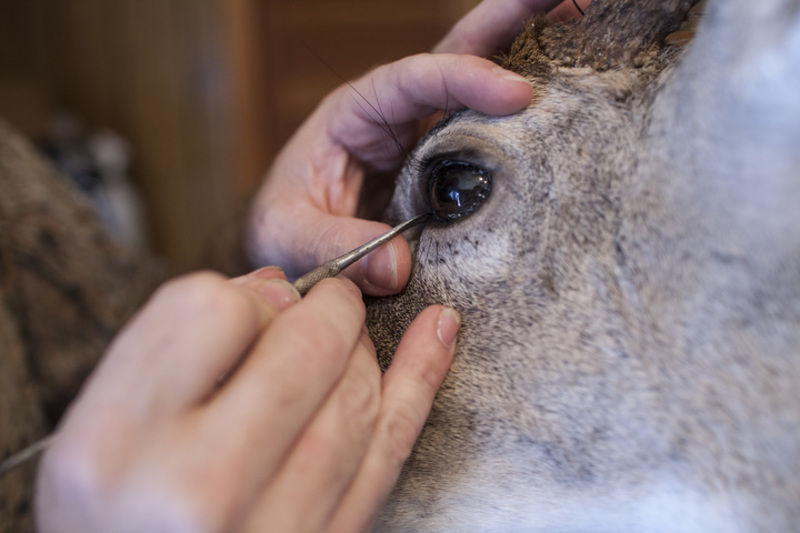
“Then you groom and paint the eyes and nose,” Cave said.
The deer’s eyes and ears are mounted using pre-made pieces purchased separately from the upper body forms, which resemble mannikins. The eyes outside a mount look like high-gloss buttons.
Cave said it’s important for the hunter to use proper field techniques on the animal prior to bringing it to him for a creation.
Cave said he wants to get his name out as providing taxidermy service in the area. A deer shoulder mount with a four- to six-week turnaround costs about $400. Other prices include coyote, $575; bobcat, $550; bass, $325; and muskie, $500.
Cave has also mounted his own deer trophies, noting there is a little more excitement when he gets to mount his own animals. Cave may be reached at 270-421-5215.
For more information on Bowling Green Taxidermy, visit bgtaxidermy.webs.com.
Life-like, three-dimensional representations
According to Taxidermy.net, taxidermy is a general term describing the many methods of reproducing a life-like, three-dimensional representation of an animal for permanent display. In some cases, the actual skin – including the fur, feathers or scales – of the specimen is preserved and mounted over an artificial armature, the website noted.
In other cases, the specimen is reproduced completely with man-made materials, according to the website.
Akeley, Horneday, Jonas and Pray are considered pioneers of modern-day taxidermy, the website noted. Their precise representations took taxidermy out of the realm of crudely stuffed animal skins where all sorts of materials, including rags and newspaper, were used to create the animal’s muscular definition.
The profession’s website noted that the finished products are mounts and they should never be referred to as “stuffed” animals.
“Professional taxidermists still shudder and take offense at the term stuffing,” the website noted.
“The first taxidermists were primitive hunter-gatherers who crudely formed animal skins over mud and rock for use in their hunting rituals,” according to Taxidermy.net. “By the 1700s almost every small town had a prosperous tannery business. In the 1800s, hunters began bringing their trophies to upholstery shops where the upholsterers would actually sew up the animal skins and stuff them with rags and cotton. The term ‘stuffing’ or a ‘stuffed animal’ evolved from this crude form of taxidermy.”
The word “taxidermy” is derived from two ancient Greek words; taxis, meaning movement; and derma, meaning skin. Taxidermy means the movement of skin, according to the definition. “Many taxidermy procedures involve removing the natural skin from the specimen, replacing this skin over an artificial body, and adjusting the skin until it appears lifelike,” the website noted.
Modern gun deer season begins this month
Cave and Taylor expect to be busy once modern gun season for deer begins in Kentucky.
Zone 2 deer gun season is Nov. 14-29, either sex. Logan and Hart counties are in Zone 2.
Nov. 14-23, either sex, are the dates for Zone 3. Allen County has been added to Zone 3 this year in addition to Simpson, Warren, Barren, Edmonson and Butler counties, according to the Kentucky Department of Fish and Wildlife Resources.
Information on all Kentucky deer hunting seasons is available at fw.ky.gov.
—Follow business reporter Charles A. Mason on Twitter at twitter.com/BGDNbusiness or visit bgdailynews.com.
