
Content
#Lookback: The Taxidermist Saddle Maker – County 10
Oct
A series where we take a #lookback at the stories and history of our community, brought to you by Mick Pryor, Financial Advisor with Edward Jones.
Tucked among the historic buildings at the Dubois Museum is a small log structure known as the Maxwell Saddle Shop. For years, the building carried a mystery along with its name. Who was Maxwell? What did he do in Dubois? And how did his little shop become part of the museum? Recent research has begun to answer those questions—and revealed that Clarence Oliver Maxwell was far more than a saddle maker.
Born in Boulder, Colorado, around 1874–75, Maxwell came from a family connected to the early development of Colorado and Steamboat Springs. His step-grandmother, Martha Maxwell, was a nationally known naturalist, hunter and pioneering female taxidermist.
By the 1890s, Clarence was working in the saddle and harness trade. His career took him across the Rocky Mountain West, including Buffalo, Wyoming; Red Lodge, Montana; Steamboat Springs, Colorado; Dubois; and eventually Salmon, Idaho.
Maxwell was a remarkably versatile craftsman. He made saddles and harnesses, worked leather, tanned hides, practiced taxidermy, hunted and guided. In Steamboat Springs, he operated from the Harwig Saddlery, advertising custom saddles, chaps, robes and taxidermy. Surviving saddles attributed to Maxwell in museum collections demonstrate the quality and decorative detail of his work.
His connection to the Wind River country began before he moved to Dubois. In 1914, Maxwell advertised in the Wind River Mountaineer, offering to purchase animal hides for taxidermy. He was among the early taxidermists serving the region, using the latest “paper method” to create lifelike mounts.
Maxwell arrived in Dubois with his wife, Grace, around late 1916. Their time together was tragically short. Grace died in Riverton in April 1917, about a month after giving birth to their daughter, Helen Irene. Helen was subsequently raised by Maxwell’s extended family in Colorado.
By 1918, Maxwell was established in Dubois as a taxidermist and saddler. His shop originally stood near the Stringer Hotel on Rams Horn Avenue. In 1919, street improvements forced the building to be moved. A newspaper reported that Maxwell was “nicely settled in his new location some fifty feet south of his former one.”
The building itself is unusual. Its logs are squared on the outside, while the rounded portions face inward, and its corners use box-notch construction. Almost as if the building were built inside out, this distinctive design makes the shop an interesting architectural artifact as well as a reminder of early Dubois.
Inside, however, the real work was taking place. Leather was cut, shaped and decorated. Saddles and harnesses were built and repaired. Hides were tanned, and animals and birds prepared for mounting. Maxwell’s shop brought together several trades essential to ranchers, cowboys and hunters.
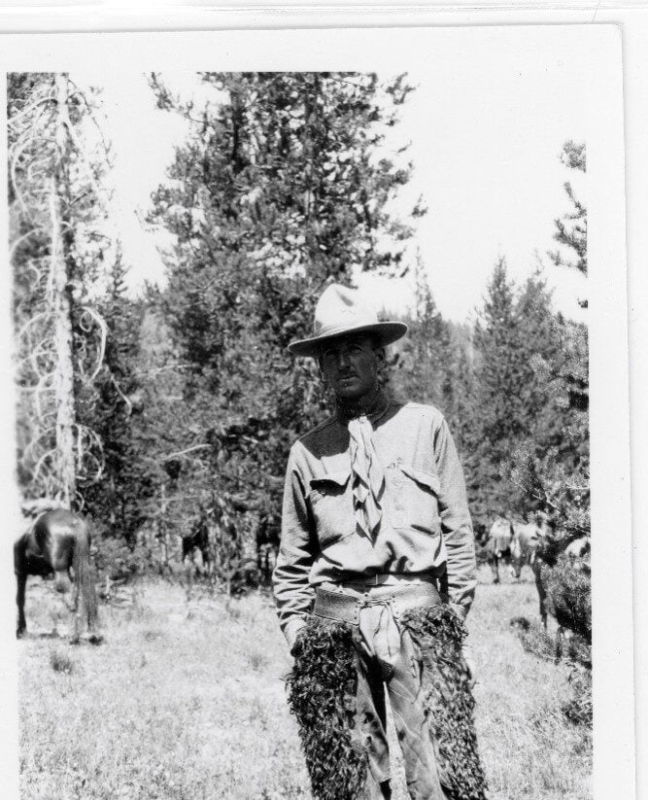
One of the strongest connections between Maxwell’s craftsmanship and the Dubois Museum is found in the collection itself. The museum has a pair of woolies—long-haired leather chaps—made by C.O. Maxwell for Charles Moore of the CM Ranch. The chaps feature elaborate tooling, including a floral poppy design, demonstrating that Maxwell’s work was not merely practical, but also artistic.
In 1918, another saddle maker from Lander advertised chaps for $20 to $30, a substantial expense at the time. Quality Western gear was an investment, built to withstand years of hard use.
Maxwell left Dubois for Salmon, Idaho, in 1921, where he opened a tanning, harness and saddlery business. A 1922 newspaper described him as an experienced craftsman who had spent 28 years in the saddle-making trade. He designed his own saddle tree, carved elaborate Mexican-style leather patterns and tanned much of the leather he used. His taxidermy business was still active, with $1,800 worth of mounted animals and birds reportedly for sale in St. Louis.
After Maxwell left Dubois, his old shop took on an entirely different role. Local history indicates that it was moved behind the Rustic Pine Tavern and converted into an ice house. Ice houses were common in early Dubois; a 1927 newspaper observed that “nearly every house in Dubois has an ice house.”
A building that once held saddles, leather and taxidermy specimens had become a place to store ice, a good example of how historic buildings were often adapted as communities changed.
In 1979, John Steele and Harold Hyman donated the building to the Dubois Museum. Preservation has continued ever since. In 2019, deteriorated logs were replaced, the roof renewed and other improvements made. In 2026, the building received another important upgrade when it was placed on a new poured-concrete foundation.
Today, the Maxwell Saddle Shop is much more than an old log building. Its story stretches from Colorado to Montana, Wyoming and Idaho, connecting Dubois with the people and businesses that shaped the Rocky Mountain West. It also reminds us that history is often hidden in plain sight.
The logs cannot tell us who Maxwell was, where he learned his trade, or what brought him from one Western community to another. Those stories emerge from newspapers, census records, family histories and objects preserved in museums.
Clarence Oliver Maxwell died in Salmon, Idaho, in 1943. He left no grand monument in Dubois. Instead, his legacy survives in saddles, leatherwork, newspaper accounts—and a small log building that bears his name.
Author: Seth McFarland Dubois Museum
Historical research for this article includes work by Katie Adams of the Steamboat Springs History Museum, as well as historic newspapers, census and registration records, museum collections and research materials in the Dubois Museum files.
Next up for the Fremont County Museum
October 6, 8am with the Dubois Museum, “Crystal Cave Trek” Wind River Visitors Council Adventure Trek Series
October 7, 6pm at the Riverton Museum, “Polished Corners of the Temple Walls Lea Cavalli Schoenewald” Wyoming Community Bank Discovery Speakers Series
October 10, 9:30am with the Dubois Museum, “Dubois Geocaching Trek w/Billy McKenney Wind River Visitors Council Adventure Trek Series
October 16 & 17, 6-9pm at the Pioneer Museum, “Halloween Night at the Museum” Children’s Exploration Series
October 17, 5:30pm with the Riverton Museum, “Haunted Downtown Riverton Walking Tour” Wind River Visitors Council Adventure Trek Series
October 24, 3-8pm at the Riverton Museum, “Fall Fest” Children’s Exploration Series
October 31, TBA at the Dubois Museum, “Kiwanis Club Halloween Party”
Daily through December at the Pioneer Museum, “Sweetwater Ranch Life, The Paintings of Jack Corbett” Exhibition Opening
Rare Relics Road Show: Save the Date: Saturday October 10, 2026 Lander, WY Lander Community Center, You Are Invited! Wind River Cultural Centers Foundation https://rarerelicsroadshow.funraise.org/
ReDiscover the Winds podcast: Season 3, Episode 1 Brought to you in part by WY Humanities https://podcasts.apple.com/us/podcast/rediscover-the-winds-season-3-episode-1-frontier/id1766312534?i=1000786299462
Call the Dubois Museum 1-307-455-2284, the Pioneer Museum 1-307-332-3339 or the Riverton Museum 1-307-856-2665 for detail regarding their programs.
The Dubois Museum, the Pioneer Museum in Lander and the Riverton Museum need your financial support. In the current economic environment, the museums are more reliant than ever on donations from the private sector to continue to provide the quality programs, collections management, exhibits and services that have become their hallmark over the last four years. Please make your tax deductible contribution through the Wind River Cultural Centers Foundation https://windriverccf.funraise.org/ or by sending a check to Fremont County Museums 450 N 2nd Rm 320 or taking it directly to the museum you choose to support.
Free news isn’t really free. So, if you valued the content you just read, consider a small “thank you” gift to help us provide more!
🔒 100% Secure Donation
Free news isn’t really free. Support County 10’s mission to connect the community!
Advertisement
Advertisement
Advertisement
Advertisement
