
Content
Award-Winning Author Divya Anantharaman Talks Taxidermy – The Colgate Maroon-News
Oct
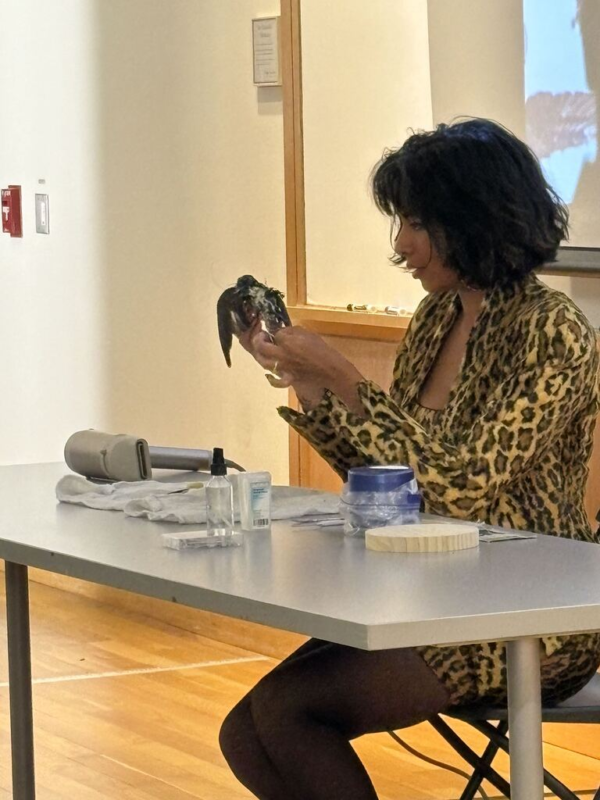
The Scientific Art of Preserving Natural Wonders events kicked off the evening of Friday, Sept. 25, with a public talk, demonstration and book signing from the award-winning Divya Anantharaman. Anantharaman is New York City’s premiere taxidermist and founder of Gotham Taxidermy, the first QTIPOC owned taxidermist studio in the five boroughs.
Anantharaman also led workshops on Starling Taxidermy and Entomology Preservation on Saturday, Sept. 26 in Olin Hall and Sunday, Sept. 27 at the Alana Cultural Center.
The practice of taxidermy has a long history and the scientific art form’s reputation has taken many hits over the years.
However, Anantharaman has made many efforts throughout their career to destigmatize the practice, including through publishing their book “Stuffed Animals: A Modern Guide to Taxidermy,” which Anantharaman co-wrote with their colleague, fellow taxidermist Katie Innamorato.
Anantharaman regularly teaches the art of taxidermy at museums, galleries, universities and shops across the world. One such taxidermy class took place at the Morbid Anatomy Museum in Brooklyn.
“[The taxidermy classes] were an immediate and insane sensation,” Joanna Ebenstein, the museum’s creative director, said in a New York Times article. “At one point we had a 600-person waiting list.”
Interest in the events this weekend was shared amongst both students at Colgate University and the greater Hamilton community.
On Friday, the presentation began with an explanation of the history of taxidermy, highlighting the advancements made by prominent taxidermists such as John Edmonstone, Martha Maxwell, Sarah Bowdich Lee and Sinclair Clark.
Anantharaman also explained the two avenues that the forms of taxidermy can take; the traditional naturalistic form is a preservation method typically used for scientific purposes, while the fantasy form showcases the more artistic side of taxidermy, such as the anthropomorphic works of Walter Potter or the creation of fantasy creatures including a jackalope.
However, the most important part of the talk and later demonstration was the showcasing of the process of taxidermy itself, as Anantharaman argued that witnessing the practice can help break down stereotypes by shedding light on the actual process.
Anantharaman finds that being a taxidermist is akin to being the apprentice to death.
“Many of the awkward interactions that I’ve had with people who don’t like taxidermy are really rooted in a discomfort with death, especially in Western society where there’s such death denial,” Anantharaman said. “A lot of times folks are like, ‘Oh, it’s hard for me to think of death, it’s super morbid,’ but I think it’s actually a very valuable way to stimulate conversations about our own mortality.”
Beyond that, Anantharaman’s work is sustainable and ethically sourced, with most of the animals they work with being under some type of human care.
“Birds like European starlings, English sparrows, and pigeons … were introduced to the U.S. and so they have no protections around now. So if you find those dead, you can pick those up and you can do taxidermy on them,” Anantharaman said. “[For birds that] are protected in the U.S. only a museum or a nature center can have those or an educator, someone with an educational permit… I also have to have … a federal permit for fish and wildlife, and those birds they usually get from salvage from either window collisions or road kills.”
In recent years, the internet has made information regarding taxidermy much more accessible to the public. When Anantharaman entered this field 15 years ago, they struggled digging through eBay, Craigslist and old garage sales to find any modicum of information on taxidermy.
Now, there are many people who do taxidermy and share it online. In doing so, more people have found themselves drawn to taxidermy. With Anantharaman’s demonstration, first-year Aimee Gonzalez found herself intrigued by the care and attention to detail shown in taxidermy.
“It was really cool to see all the small details and things that go into the process, like the difference between using glass or acrylic beads or using a certain kind of paste that allows flexibility of the skin as positioning occurs,” Gonzalez said.
That said, most people who have found themselves drawn to this scientific art are most interested because it’s a way to reconnect with nature in an increasingly technological world.
“People are really desperate to connect to nature and to connect to something that is not digital. I like technology. I’m not an anti-technology person. If it wasn’t for technology, I wouldn’t have a practice… But I think that there’s this hyper presence of technology in our lives where if you go to a restaurant, you have to use an app to order. And if people want to get away from that, they want to have something that’s just in their hands. I think its just wanting to bring some nature close to you,” Anantharaman said.
Your email address will not be published.
