
Content
Bwana Simama, the German who taxidermied Kenya – MalindiKenya.net
Nov
KENYAN STORIES
05-11-2026 by Freddie del Curatolo
When big-game hunting was one of the reasons why Africa attracted aristocrats, adventurers and millionaires from all over the world, Nairobi was also an international capital of trophies – a sombre yet historically well-known passion shared by many.
Lions, giraffes, buffalo, zebras and elephants were taken from the Kenyan savannahs only to end up stuffed in the homes of kings, presidents and collectors. The man who shaped that industry in Kenya was a German naturalist, Paul Zimmermann, whose name lives on today in one of the capital’s most populous neighbourhoods.
Karl Fritz Paul Zimmermann was born on 29 January 1888 in Silesia, then part of the German Empire. A naturalist, zoologist and taxidermist, he had studied in Germany, attending scientific institutions and museums, including the University of Jena, the Natural History Museum in Wiesbaden and the Zoological Museum in Hamburg. He was also in charge of dermoplasty at the Umlauff studios in Hamburg, which specialised in the reconstruction of animals for museums and collectors.
Dermoplastics was a particularly elaborate form of taxidermy: it was not simply a matter of preserving a skin, but of restoring a semblance of life to the animal through an anatomical model. A lion could once again bare its fangs, a giraffe stretch its neck, and a buffalo charge. Death was transformed into a representation.
Zimmermann served in the German army during the First World War. His first experience of Africa is said to have been linked to a hunting expedition, whilst other biographical accounts speak of a zoological mission organised by a German university. In 1929, he settled permanently in Nairobi, where the allure of wildlife and the economic opportunities associated with safaris had by then become part of an international industry.
Initially, he worked for Chas A. Heyer & Co., a firm specialising in big-game hunting and the sale of sporting firearms. Following the owner’s death in 1931, Zimmermann took over the taxidermy business and, in 1934, acquired the firm outright, gradually building a company that was destined to become one of the most important in the sector.
Bwana Simama, the boss who said ‘stop’
Among the African workers at the factory, Zimmermann was known as ‘Bwana Simama’. In Swahili, bwana means ‘sir’, ‘boss’ or ‘man of standing’; simama means ‘to stop’, ‘to stand still’ or ‘to remain motionless’.
The exact origin of the nickname is not documented by any direct testimony, but tradition has handed it down as a name linked to the way he addressed his employees.
It is a name that seems almost to encapsulate, unwittingly, the essence of his craft: to freeze the animal, to halt its movement, to fix it in an eternal pose. The savannah, with all its unpredictability, was immobilised to become a piece of furniture.
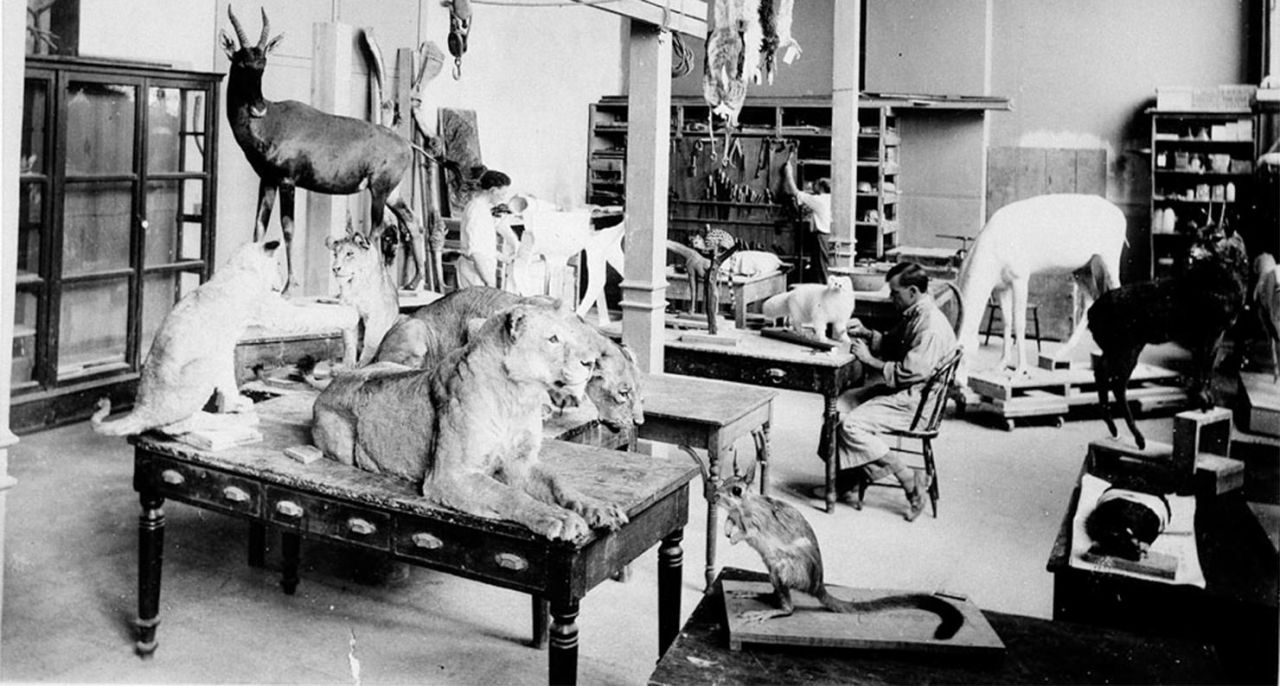
Zimmermann’s factory was situated on the northern plains of Nairobi, near the Ruaraka River. Here, far from the town centre, a tannery and the facilities required for leather processing were also built.
At the time, the area was an almost rural outskirts. There were none of the high-rise buildings, traffic, shops or congested roads that characterise the area today. There were open fields, vegetation, animals and a business operating for an international market.
Trophy hunting in Africa: a custom from another era
To understand Zimmermann’s success, one must understand the mindset of his time.
In the first half of the 20th century, big-game hunting was considered a legitimate sporting activity, particularly amongst the European and American aristocracy and middle classes. African hunting expeditions attracted nobles, military officers, industrialists, writers and politicians. Some were organised with professional guides, licences and rules; others went far beyond the bounds of legality.
The trophy was the tangible symbol of the feat. A lion’s head, a zebra’s hide, the horns of a kudu or the tusks of an elephant represented a memento of an expedition, proof of success, and the prestige of those who had confronted an animal considered dangerous.
Among the great safari enthusiasts was Theodore Roosevelt, President of the United States from 1901 to 1909, who took part in a famous African expedition in 1909–1910. His collection of specimens helped to fuel international interest in African wildlife and zoological collections.
At that time, nature conservation was not yet the dominant principle that we recognise today. Wild animals were regarded as an abundant resource, a heritage to be exploited, studied, hunted or exhibited. Hunting was often celebrated as a test of courage and skill, and trophies were displayed in homes, clubs, hotels and museums.
It would be unfair to judge every key figure of that era by today’s standards, whilst ignoring the historical context. Nor, however, can we forget that hunting pressure, together with the illegal trade and habitat loss, contributed significantly to the decline of numerous species.
Zimmermann’s own business thrived amidst this contradiction: on the one hand, the craftsmanship and scientific skill involved in reconstructing the animals; on the other, an economic system that profited from their killing.
A factory for kings, presidents and museums
Zimmermann Ltd became one of the world’s largest taxidermy firms, second only – according to reports gathered by the Kenyan press – to the Jonas Brothers in Denver, USA.
The factory came to employ around a hundred people and worked on over 400 safaris a year. Its products found their way to private collectors, museums, historic hotels, clubs and the residences of international figures.
The catalogue was impressive. The company produced whole animals, heads of large mammals, rugs made from hides, tusks and objects crafted from animal parts. The requests could be eccentric: bottle openers made from warthog tusks, bags made from elephant ears, pendants made from lion claws, and bracelets made from elephant tail hair.
Some of the trophies produced by the factory can still be found today in Kenya’s historic hotels, museums and certain private collections. Even State House in Nairobi purchased decorations made by the company.
In the 1970s, the factory worked for the museum of Philippine President Ferdinand Marcos, who was among its international clients.
The business was an industrial enterprise, yet retained an artisanal dimension: each animal required anatomical expertise, modelling skills, knowledge of hides and great attention to detail. The workers did not merely taxidermy; they reconstructed the appearance of life.
The hunting ban and the end of Zimmermann Ltd
In the 1960s and 1970s, the decline in Kenya’s wildlife populations became increasingly evident. Big-game hunting, poaching and the trade in ivory and other animal products were placing unsustainable pressure on many species.
In 1973, Kenya introduced a ban on elephant hunting. In 1977, protection was extended to all wildlife through a general hunting ban, accompanied by an order for licensed hunters to hand in their weapons.
For Zimmermann Ltd, this spelled the end. Without animals from safaris and hunting activities, the factory could no longer sustain its business model. In December 1977, it closed its doors for good.
The trophy industry, which for decades had been a major contributor to Nairobi’s tourism and commercial economy, suddenly found itself sidelined by the country’s new direction.
The closure was not merely the end of a business. It was also a sign of a different approach to African wildlife: from a resource available for hunting to one to be protected, including for future generations.
From trophy factory to working-class neighbourhood
Paul Zimmermann did not live to see the decline and closure of his company; he died six years before hunting was abolished, on 12 April 1971 in Nairobi, from complications related to diabetes. Nor would he have witnessed the transformation of the land on which it stood.
After the business ceased trading, the property was sold and, over time, subdivided for residential development. New Roysambu Housing Company purchased the land and began marketing plots of around 350 square metres, at starting prices of 6,600 Kenyan shillings.
In 1978, the water supply was extended and the following year the first primary school was built. By 1989, around 1,300 plots had been sold.
One of the factory’s final projects – and perhaps the most significant – was the preparation of Ahmed, the famous elephant of Marsabit.
Ahmed had become a national symbol. His enormous tusks had attracted the attention of poachers, but in 1970 President Jomo Kenyatta intervened with a decree to protect him. The animal was placed under protection and became a sort of living monument to Kenya’s wildlife.
When Ahmed died in 1974, his body was prepared for display at the National Museums of Kenya. His taxidermied form is still preserved today at the National Museum in Nairobi.
Zimmermann’s workshop, which had built its fortune by turning hunted animals into trophies, thus helped to preserve the image of one of the most important elephants in the history of wildlife conservation in Kenya.
A paradox that aptly illustrates the transition of an era: the trade of those who had made the death of animals a commercial enterprise ended up also safeguarding the very symbol of their conservation.
A name that outlives its era
The name of the old factory remained. Zimmermann, simplified to Zimmerman, became the name of the neighbourhood.
Today, ‘Zimma’, as its residents affectionately call it, is a densely populated area along Thika Road, in the Kasarani urban belt. Shops, restaurants, flats, schools and commercial premises have taken the place of the industrial sites and open spaces of yesteryear.
According to the 2019 census, the census area of Zimmerman had a population of around 49,500. This growth has transformed the neighbourhood into an important part of modern-day Nairobi, with a vibrant daily economy, but also with the difficulties typical of high-density urban settlements: drainage, waste management, infrastructure and pressure on services.
Those living in Zimmerman today are unlikely to think of a German naturalist, big-game hunting or a taxidermy workshop. The name has become a mere geographical reference, part of everyday life in Nairobi.
Yet, beneath the neighbourhood’s streets and homes, the memory of another Africa remains. An Africa in which wildlife was regarded as a resource to be captured, in which armed expeditions were celebrated as heroic feats, and in which hunting trophies adorned the drawing rooms of the powerful.
Paul Zimmermann was one of the leading figures of that world. A naturalist, craftsman and entrepreneur, he built an international business through a trade that today evokes mixed feelings, ranging from admiration for the technical skill involved to unease about its relationship with wildlife.
His nickname, ‘Bwana Simama’, now seems like a small twist of history. The man who ‘stopped’ animals to preserve them motionless for posterity has lent his name to a neighbourhood which, by contrast, has never stood still: it continues to grow, change and thrive, in the heart of modern Nairobi.
PODCAST
by redazione
econd episode of Freddie del Curatolo's podcast on the history of Italians in Kenya…
READ THE ARTICLE
ITALIAN PODCAST
by Freddie del Curatolo
This week sees the return of an Italian podcast from Kenya, telling the remarkable story of how…
READ THE ARTICLE
PODCAST
by Freddie del Curatolo
LISTEN HERE!
READ AND LISTEN
by Freddie del Curatolo
In recent days, with the preview of the trailer, I launched the first podcast by Italians in Kenya, a…
READ THE ARTICLE
ITALIAN PODCAST
by Freddie del Curatolo
What happened in Kenya in 1990?
And why does…
READ THE ARTICLE
ITALIAN PODCAST
by redazione
The Podcast degli Italiani in Kenya (Podcast of Italians in Kenya) returns this Tuesday with the series…
READ AND LISTEN
PODCAST
by redazione
Like every Tuesday, it's time for the History of Italians in Kenya, narrated by Freddie del Curatolo in…
READ THE ARTICLE
PODCAST
by redazione
Starting today, as every Tuesday, the fourth episode of Freddie del Curatolo's PODCAST…
READ AND LISTEN
ITALIAN PODCAST
by redazione
Our fascinating, adventurous historical journey to the origins of Kenya continues, exploring…
READ AND LISTEN
SHOW
by redazione
Have you ever wondered what a rhino might think of us mzungu?
Or if …
READ ALL THE ARTICLE
ITALIANI IN KENYA
by Freddie del Curatolo
I didn’t expect this, and I have to thank you all—especially you, my readers, who after so many years have…
READ THE ARTICLE
ITALIANS IN KENYA
by redazione
The second season of Freddie del Curatolo's hugely popular PODCAST on the history…
READ AND LISTEN
WILDLIFE
by redazione
Some of the most eminent international zoologists and conservationists called in a letter published in…
READ THE ARTICLE
WILDLIFE
by redazione
Since the beginning of the year, a devastating phenomenon of wild animal poisoning has not…
READ THE ARTICLE
ONLINE INITIATIVE
by Freddie del Curatolo
It's about time!
For a long…
READ THE ARTICLE
