
Content
California becomes first state to ban fur trapping after Gov. Newsom signs law – Los Angeles Times
Oct
SACRAMENTO — California has enacted a new ban on fur trapping for animal pelts, making it the first state to outlaw a centuries-old livelihood that was intertwined with the rise of the Western frontier.
The Wildlife Protection Act of 2019, signed into law by Gov. Gavin Newsom on Wednesday, prohibits commercial or recreational trapping on both public and private lands.
Assemblywoman Lorena Gonzalez (D-San Diego), who introduced the legislation, said it was time to end fur trapping. “It seems especially cruel, obviously, and it’s just unnecessary and costly,” she said.
Although commercial trapping was an early part of California’s economy, opening the San Francisco Bay Area to international commerce even before the 1848 California Gold Rush, its fortunes have waned over many decades.
Gonzalez said that the roughly six dozen trappers still working in the state, down from more than 5,000 a century ago, cannot afford to pay the full cost of implementing and regulating their industry.
The ban also comes as California lawmakers consider more aggressive measures to protect animals and wildlife, often threatening age-old traditions.
Legislators are considering proposals to ban the sale of all fur products, including fur coats, and to outlaw the use of animals in any circus in the state, with the exception of domesticated horses, dogs and cats.
“There’s been a real change in attitudes about how we treat animals,” Gonzalez said.
A total of 68 trappers reported killing 1,568 animals statewide in 2017, according to the California Department of Fish and Wildlife. Among the 10 species reported taken were coyote, gray fox, beaver, badger and mink.
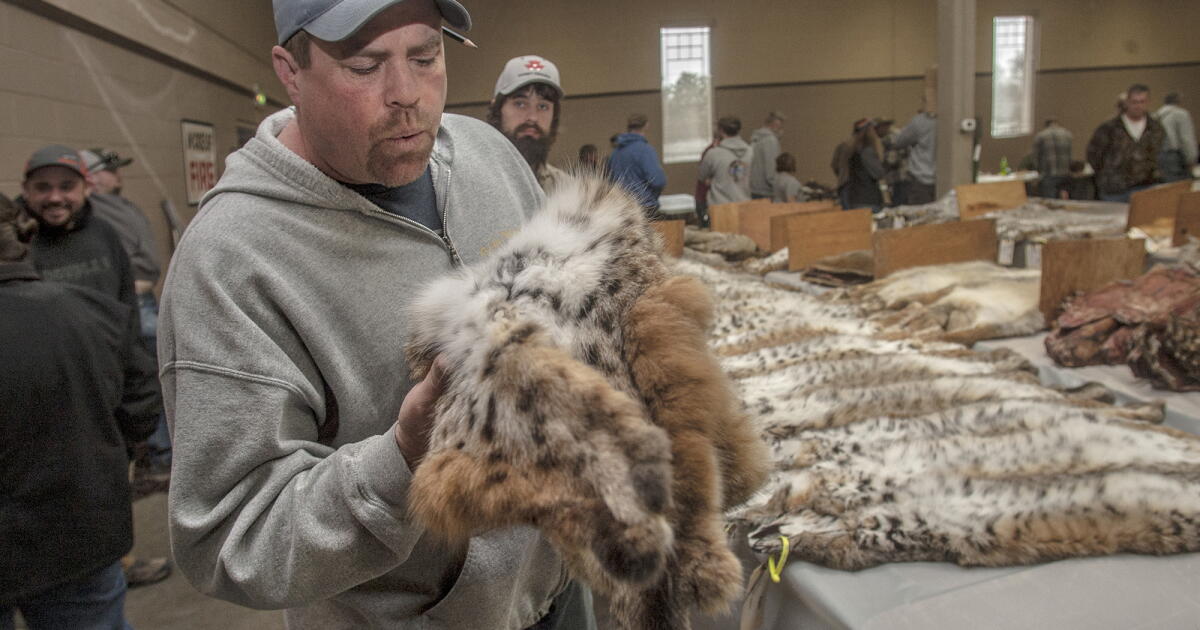
Trapped animals are strangled, shot or beaten to death, with care taken not to damage pelts before skinning them.
Under the law, using traps to catch gophers, house mice, rats, moles and voles would still be permitted.
The law followed a 2013 public outcry when conservationist Tom O’Key in 2013 discovered a bobcat trap illegally set on his property near the edge of Joshua Tree National Park.
O’Key stumbled upon the trap chained to a jojoba bush and camouflaged with broken branches just north of the 720,000-acre park, where the big cats are a dominant force in the ecosystem.
He immediately alerted neighbors and contacted the San Bernardino County Sheriff’s Department and Hi-Desert Star newspaper, triggering an angry tide of complaints that put a spotlight on the practice of trapping, killing and skinning bobcats to supply fur markets in China, Russia and Greece.
“I could not have guessed in a million years,” O’Key said in an interview, “that trap would spark an unstoppable movement capable of shifting legislative thinking toward wildlife.”
Assemblyman Richard Bloom (D-Santa Monica) pushed through his Bobcat Protection Act of 2013, which was in response to petition drives, social media campaigns and telephone calls to lawmakers from wildlife advocates who decried trapping and killing as a cruel trade.
Eight months after O’Key sounded the alarm in Joshua Tree, the California Fish and Game Commission voted 3 to 2 to ban commercial bobcat trapping statewide.
The Wildlife Protection Act of 2019 argues that the small number of active trappers in the state cannot afford to pay the full cost of implementing and regulating their industry as required by law.
It was backed by the Center for Biological Diversity, and the nonprofit group Social Compassion in Legislation, which spearheaded a recent bill that put an end to the sale of mill-bred dogs, cats and rabbits.
Opponents included the California Farm Bureau Federation, which warned that the bill, if passed, could have significant economic consequences for the agriculture industry.
The trapping industry declined over decades in California.
Before California’s population ballooned to roughly 40 million people, fur trapping played a significant role in the extirpation of wolves and wolverines and the severe declines of sea otters, fishers, martens, beavers and other fur-bearing species.
Over the last two decades, animal protectionists have partnered with mainstream environmental groups to put pressure on state and federal wildlife authorities, and to take their animal-cruelty concerns to the voters. Trappers are anachronistic, they said, and their snares subject wildlife to horrific suffering.
“The signing of this bill into law is the result of compelling data and a change of heart in public opinion regarding animal cruelty,” said Judie Mancuso, founder and president of Social Compassion in Legislation.
The most important California stories and recommendations in your inbox every morning.
By continuing, you agree to our Terms of Service, which include arbitration and a class action waiver. You agree that we and our third-party vendors may collect and use your information, including through cookies, pixels and similar technologies, for the purposes set forth in our Privacy Policy such as personalizing your experience and ads.
Follow Us
Louis Sahagún is a former Los Angeles Times staff writer who covered issues ranging from religion, culture and the environment to crime, politics and water. He was on the team of L.A. Times writers that earned the Pulitzer Prize in public service for a series on Latinos in Southern California and the team that was a finalist in 2015 for the Pulitzer Prize in breaking news. He is a former board member of CCNMA: Latino Journalists of California and author of the book “Master of the Mysteries: The Life of Manly Palmer Hall.”
Follow Us
Phil Willon is the California politics editor based in the Sacramento bureau of the Los Angeles Times and oversees coverage of state politics and the state capital.
California
California
California
On screen, Errol Flynn played a series of daredevils, fortune hunters, and suave romantics. Off screen, he lived a life of outsize debauchery and recklessness, including a persistent interest in underage girls. In 1943, at the height of his fame, he faced trial in Los Angeles on charges of statutory rape.
In our first episode, the L.A. Times columnist George Skelton sizes up the governors he’s known, what made them successful and whether the next one can measure up.
How do you get more people to care about climate change — and tell riveting stories along the way? Boiling Point explored that question at a live event during this year’s New York City Climate Week at Columbia University’s Climate School.
California
California
Subscribe for unlimited access
Site Map
Follow Us
MORE FROM THE L.A. TIMES
