
Content
Wildcat mother defends her young against a wolf – Wild beim Wild
Sep
Enter a search term above and press Enter to start the search. Press Esc to cancel.
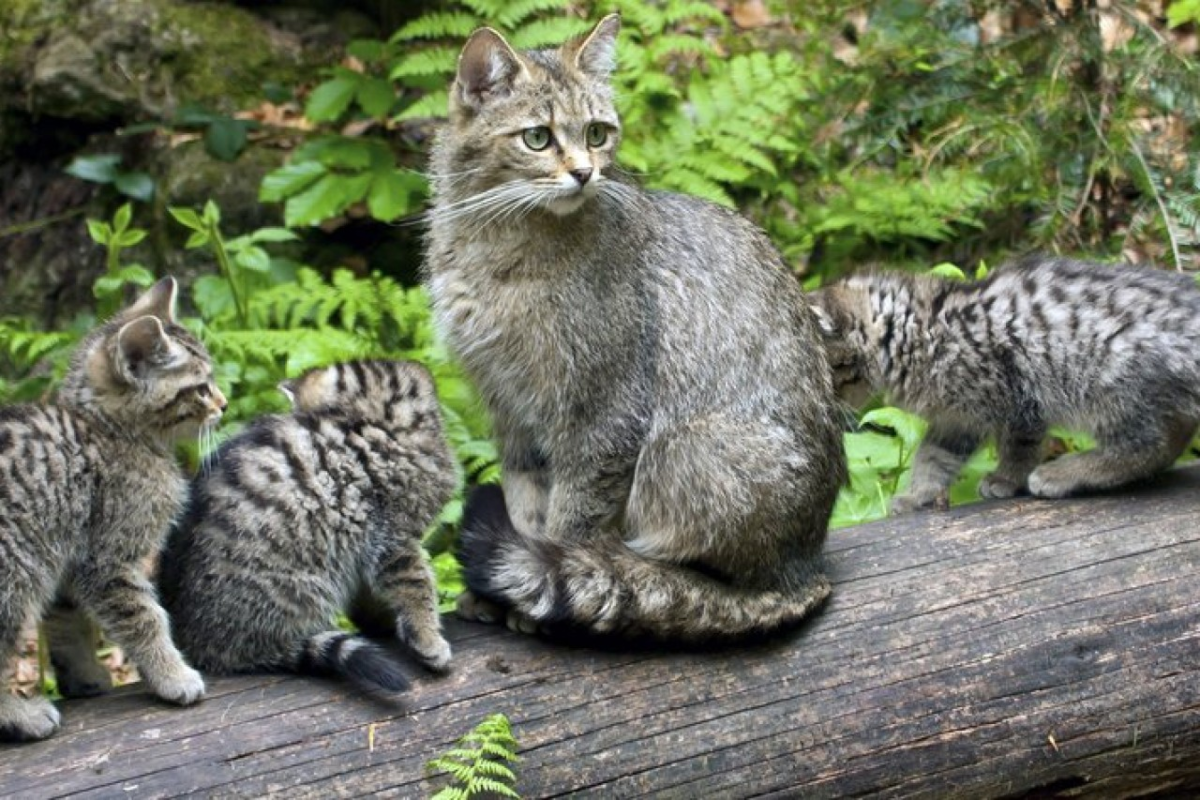
Extremely agitated, the wildcat mother lashes her puffed-up tail back and forth. Her fur is bristling, her ears pointed forward. Again and again she arches her back threateningly and hisses, as she paces tensely along a tree trunk in the night. She has offspring, and lurking in the background is a formidable opponent:
Extremely agitated, the wildcat mother lashes her puffed-up tail back and forth. Her fur is bristling, her ears pointed forward. Again and again she arches her back threateningly and hisses, as she paces tensely along a tree trunk in the night. She has offspring, and lurking in the background is a formidable opponent: a wolf.
«The footage from our camera trap is a small sensation,» says Malte Götz, wildcat expert at the Deutsche Wildtier Stiftung. «The willingness of a wildcat mother to stand her ground against a wolf for the sake of her young has been documented for the very first time.»
In the video you can follow how the courageous animal is at the peak of tension and ready to fight.
The camera trap footage was captured as part of a telemetry study examining the habitat requirements of wildcats far from forested upland regions — their most important refuges — in Saxony-Anhalt. There, the wildcat has survived in the Harz mountains, which today also represents the core of its range.
«In recent years, this strictly protected species has been reclaiming some of its former habitats,» says Malte Götz. «This includes the North German Lowlands.»
The Deutsche Wildtier Stiftung supports the reestablishment of the wildcat and investigates, among other things, which shelters in heathland and floodplain landscapes are used for raising young and for daytime rest. “It is important to know which structures are significant and what dangers threaten the species in the cultivated landscape.” The defense against the wolf – as documented by the wildlife camera – shows that wildcats face natural challenges with courage. The return of predators such as the wolf is also a gain for the ecosystem.
The natural range of the wildcat extends from Scotland and Western Europe through Central and Eastern Europe to Central Asia and western India. It also inhabits large parts of Africa, with the exception of the tropical rainforest areas of Central Africa.
The European wildcat or forest cat (Felis silvestris silvestris) is found in Europe, on some Mediterranean islands, in Anatolia, as well as in the Caucasus and North Caucasus, and is distinguished above all by its bushy tail, which ends in a broad, blunt rounded tip. At the end of the tail there are often three black “rings.” The coat is dense, and the striped pattern is quite striking, though often blurred.
More on the subject of recreational hunting: In our dossiers on recreational hunting gather fact-checks, analyses and background reports. The scientific evidence is presented in the overview Studies on the Effects of Recreational Hunting.
The position of IG Wild beim Wild: IG Wild beim Wild rejects recreational hunting. Our model is the canton of Geneva, which has managed without recreational hunting since 1974: without hunting seasons, without hunting dogs, without driven hunts, without high seats, without the animal cruelty and crime that go hand in hand with hunting season elsewhere. What has worked there for over fifty years disproves every position paper by JagdSchweiz. An association that bases its policy on claims it refutes in its own documents is not a professional organisation, but a factory for misinformation.
With your donation you help protect animals and give them a voice.
Campaign
End fox hunting
Fox hunting cannot be scientifically justified. Find out why and how you can support the campaign.
No lynx kills in Valais
The lynx is genetically at its limit, yet Valais wants to become the first canton in Switzerland to allow its kill.
Facts & Analyses
Read more
We are committed to an ethical understanding of wild animals and hunting, following the example of the the canton of Geneva. Facts instead of hunters’ tales.
A satirical guide for aspiring recreational hunters.
Let’s stay in touch!
We’d love to send you the latest news and updates in our newsletter. Monthly compact information about hunting and wildlife!
The IG Wild beim Wild is a non-profit animal rights organization. Its primary focus is the protection of wild animals from recreational hunting.
One doesn’t become an opponent of hunting out of boredom, but out of knowledge of this animal cruelty. For professional wildlife protection.
