
Content
Bad news for bears: black bear killing hurts California grizzly reintro hopes – Animals 24-7
Sep
Animals 24-7
News on dogs, cats, horses, wildlife, zoonoses, & nature
By 
DOWNIEVILLE, California––The November 8, 2023 discovery that Patrice Miller, 71, had been eaten by a black bear inside her remote Sierra County rented home, 50 miles northwest of Lake Tahoe, was bad news for bears everywhere, whetting the fear of bears that gets hundreds of bears killed every year for no reason more substantial than panic.
Investigators initially believed Miller had died from natural causes, before the bear ate her.
But the California Department of Fish & Wildlife disclosed on June 6, 2024 that an autopsy showed the bear had actually killed Miller by breaking her neck.
That was even worse news for both black bears and brown bears––especially within the state of California, and even though brown bears, or grizzlies, have not actually lived in California or in any adjacent state in 100 years.
Sierra County sheriff’s deputies found Miller’s remains while conducting a welfare check at request of the victim’s daughter, who had not heard from her mother in several days.
“Upon showing up,” Sierra County sheriff Mike Fisher told Lysée Mitri of KCRA television news, the deputies “immediately saw evidence of bear intrusion into the house.
“The door was broken. There was bear scat on the porch. It appeared that the bear had probably been there several days, feeding on the remains.
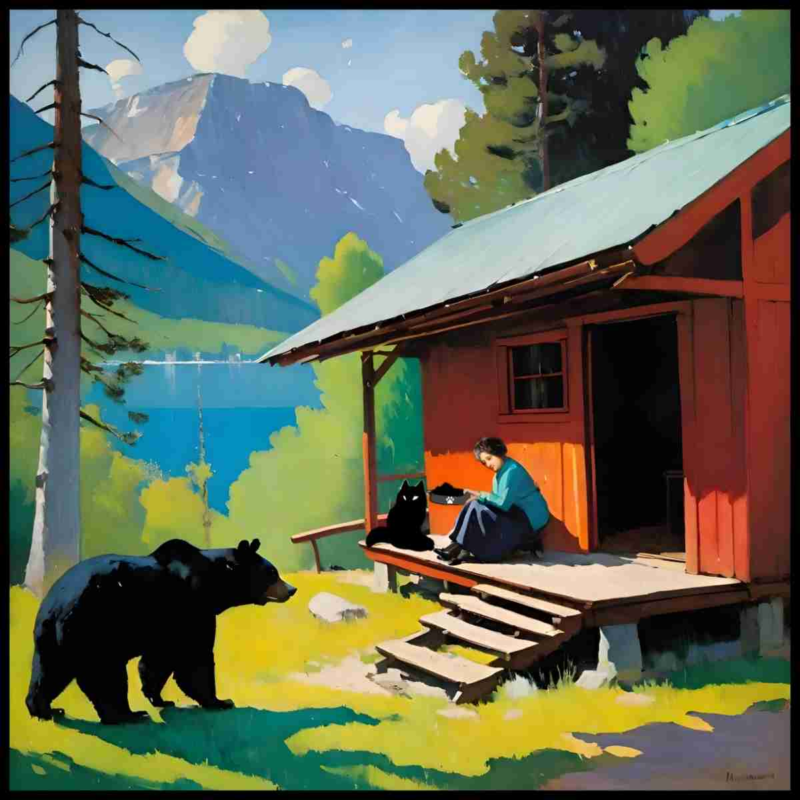
“This particular house had a lot of bear attractants,” Fisher explained to Mitri. “It had a lot of garbage. Patrice had cats and would feed them on the front porch of the house with cat food.”
Continued Mitri, “A sheriff’s office report shows Miller’s daughter said that ‘Bears were constantly trying to get in through broken windows, and that her mother had physically hit one to keep it from entering her residence. A bear her mother named ‘big bastard’ was a frequent visitor to the residence.”
The bear was trapped and shot nearby. DNA analysis confirmed that the big male was indeed the killer.
Down to about 10,000 in the 1970s through the combination of aggressive hunting, predator control, and habitat loss, the California black bear population, has recovered to an estimated 25,000 to 35,000.
Along the way, black bears have become a frequent nuisance in the resort and retirement communities of the Sierra Nevadas, including around Downieville, population 300, and on both the California and Nevada sides of Lake Tahoe.
Some Californians, slow to learn not to feed bears, even accidentally, persist in leaving garbage cans unsecured, storing fishing equipment where bears can smell it, and leaving bird feeders full overnight.
Bears raiding yards, parked cars, unoccupied cabins, and sometimes even occupied homes had already raised a hue and cry for more bear hunting.
So have conflicts involving dogs.
Among the incidents stirring alarm, a 56-year-old woman named Allena Hansen “was attacked on July 22, 2008 while walking with her two dogs on her property in the Piute area, near the little community of Caliente, about 85 miles north of Los Angeles,” Associated Press reported.
“She suffered very extensive injuries to her face while sparing her vital structures,” Ronald Reagan UCLA Medical Center surgeon Kimberly Lee told media. “Her forehead-scalp was completely hanging off to the side, and she had an indentation of her bone where the bear’s claw tore through her face,” Lee explained.
“Despite her injuries she managed to drive to a fire station and get help. She was flown to Los Angeles,” Associated Press added.
Just over a year later, on September 3, 2009, a 39-year-old man named Mike Stricklin, walking with his one-year-old dog Dakota, accidentally came between a mama bear and her cub on a Stanislaus National Forest road, near Avery. Stricklin survived with head injuries.
Five years after that, reported Veronica Rocha for the Los Angeles Times on September 25, 2014, “One minute, Emily Miles was walking her dogs in a Santa Barbara County avocado grove. The next, a hulking 300-pound black bear was sinking teeth into her left thigh after tackling her to the ground.”
Miles, of Carpinteria, fought the bear off, but “suffered a cracked rib and deep claw marks on her back,” Rocha wrote.
Scariest of all, to many people, was the unwitnessed October 2014 death of Marion Williams, 65, near Redway in Humboldt County. His remains were found in a bear’s den five days after his death.
Humboldt County deputy coroner Roy Horton told media that he believed Williams died in front of his trailer from a heart attack, and that his body was discovered and dragged away by the bear some time afterward.
There are no records in California of bears killing humans, California Department of Fish & Wildlife spokesperson Andrew Hughan told media then.
“Black bears are not dangerous animals, but if they associate our homes or cabins or campgrounds as an easy source of food they lose their natural fear of people and their actions get bolder and bolder,” reiterated another California Department of Fish & Wildlife spokesperson, Peter Tira, to Hannah Fry of the Los Angeles Times after Patrice Miller’s death.
“This is the most extreme example we’ve seen in state history,” Tira insisted.
But that all depends on which bears one is talking about, when, and overlooks that to most of the public a bear is a bear is a bear, even if grizzly bears are a distinctly different yet closely related species.
On June 3, 2024 the U.S. Fish & Wildlife Service announced a plan to restore grizzly bears to the Northern Cascades mountains of eastern Washington state, “under section 10(j) of the Endangered Species Act,” explained Brian Sweeney of the Western Environmental Law Center, “which allows it to establish experimental populations of listed species outside their current range.”
Conservationists hoped a similar plan might be adopted to reintroduce grizzly bears to the northern Sierras, believed to offer habitat sufficient to support 500 grizzlies. This is about half the number now living in the Greater Yellowstone Ecosystem, including Yellowstone National Park, Grand Tetons National Park, and other protected habitat as far north as Glacier National Park, bordering on Alberta province, Canada.
Some designated 2024 “The Year of the Bear,” lobbying for reintroduction exactly 100 years after the last native grizzly was last seen in Sequoia National Park.
The 1924 last confirmed sighting came two years after a grizzly was reportedly shot, but the remains not found, about 50 miles west in Tulare County.
Scientific and historical evidence has suggested that the California grizzlies, dubbed “golden bears” for their light cinnamon color, were never really the threats to humans and livestock that they were believed to be during the Spanish mission and Gold Rush eras.
(See Study exonerates California golden bears, & Joaquin Miller, just a bit.)
Reintroducing grizzly bears to the northern Sierra Nevada range would bring back a natural competitor and predator of black bears, much as reintroducing wolves to the northern Rocky Mountains brought back a natural competitor and predator of coyotes.
As with wolves and coyotes, restoring grizzly bears would likely substantially reduce the black bear population, in turn reducing human conflict with black bears, while grizzly bears, like wolves, would tend to keep a greater distance from humans other than those deliberately intruding into their relatively remote and wild habitat.
But just because the California grizzly bears of the 19th century and earlier were not the threat they were believed to be hardly means they were no threat at all.
Multiple California place names memorialize two of the earliest California grizzly bear victims whose deaths are documented.
The unincorporated town of Lebec, California, in the Tejon Pass, halfway from Los Angeles to Bakersfield, population 1,250, is named for Peter Lebec, whose actual name may have been Pierre Levesque.
Believed to have been a Hudson’s Bay Company fur trapper, Lebec was killed by a bear, probably a grizzly, on October 17, 1837, and was buried beneath a valley oak tree at one corner of the property that in 1854 became Fort Tejon, in Kern County.
A Native American guide on July 31, 1847 showed Robert S. Bliss and two fellow members of the U.S. Army Mormon Battalion the memorial inscription carved into the oak tree.
Bliss found a skull that the guide said was that of the bear who killed Lebec, Bliss recorded in his diary.
The grave was also documented by soldier William Phipps Blake in 1853, while accompanying surveyor Robert S. Williamson; William Ingraham Kip, the first Episcopal bishop in California, in 1855; and by Hungarian naturalist John Xantus, who spent the years 1857-1859 at Fort Tejon.
Finally, in 1890, a group of Bakersfield amateur historians including Kern County sheriff Henry L. Borgwardt Jr. removed the inscription from the tree for museum preservation at Fort Tejon, where it remains, and exhumed the grave, finding the skeleton of a man who fairly obviously had been severely mauled by a bear.
William Waddell, a Kentuckian, came to California in 1851, during the Gold Rush years, but turned to lumbering in 1862, building a sawmill on what became known as Waddell Creek, between Santa Cruz and San Francisco, just south of Año Nuevo State Park, a major breeding habitat of elephant seals and California sea lions.
Waddell later built a lumber-hauling tramway down from the mill to what is now Waddell Beach, and built a wharf to ship lumber to San Francisco.
A grizzly bear killed Waddell in 1875. The Rancho del Oso Nature & History Center on Waddell Marsh in Big Basin Redwoods State Park recalls the incident.
Killed by a California golden bear on June 25, 1860 in the hills above Monterey was a 26-year-old Pennsylvania-born cowboy named Bradley Woodward.
Pursuing a bear believed to have killed cattle, Woodward, armed with both a rifle and a revolver, dismounted from his horse to track the bear up a steep wash.
Eventually Woodward fired the rifle at the bear from behind a rock, but the possibly wounded bear was on him before he could reload or use the revolver.
With “head and face chewed nearly to pieces and blinded,” according to news accounts, Woodward “staggered three quarters of a mile down a creek toward his horse” before he died.
His remains were discovered four days later.
A Missourian named Milton McCoy is believed to have been killed by a bear near Weaverville in the Trinity Alps circa 1868. His life and death, however, are known only from an inquiry by W.D. White of Butler, Missouri, seeking anyone who might have known him, published by the Ukiah Republican Press of March 2, 1906.
In the same vicinity, an “old hunter” named Halleck disappeared in June 1871 near Swift Creek, Trinity Center. Halleck, perhaps the same man as Milton McCoy, was believed to have been possibly killed by a bear, but his remains were not found.
The last known victim of a bear in California, before Patrice Miller, was an unidentified man whom two other men saw, separately, on a mountain trail shortly before a grizzly mauled him beyond recognition in November 1888, near the unincorporated town of Tollhouse in Fresno County.
The victim was buried without authorization from the Fresno County coroner several days before “a man named Morrison” made the death known by describing the attack to the Fresno Weekly Republican.
Subscribe to get the latest posts sent to your email.
Filed Under: Bears, Dogs, Dogs & Cats, Endangered species, Feature Home Bottom, Feral & “nuisance” wildlife, Fur trapping, Hunted species, Hunting & trapping, Laws & politics, USA, Wildlife

In so many instances and places, Santayana’s immortal quote, “Those who do not learn history are doomed to repeat it,” and it applies here.
Sharing with gratitude and much more.
©
Copyright 2014-2026
