Content
X-ray reveals taxidermied thylacine head has 'full, uncut skull' – ABC News & Headlines – Australian Broadcasting Corporation
Aug
Source:936 ABC HobartProgram:Hobart Breakfast
Brought to you by
Presented by
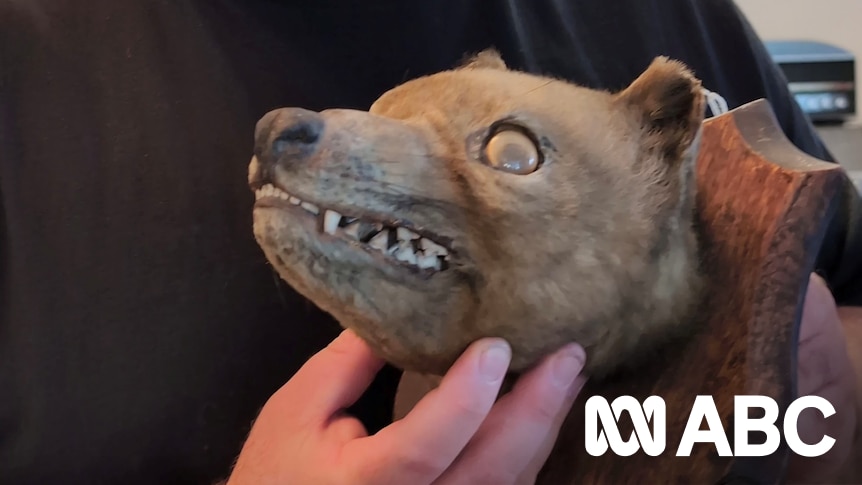
British collector James Cranfield bought a mounted head for more than 60,000 British pounds after he realised it was not a fox's, but the skull of a now-extinct Tasmanian tiger.
There has been global interest in the story of the head, and many finding its "plastic googly eyes" amusing.
Mr Cranfield has since had the head X-rayed, and shares the results with Hobart Breakfast's Ryk Goddard.
Ryk also asks him whether the googly eyes will stay.
"Well the fact that this head has now made international news literally around the world and it has been pictured with said googly eyes, the public and I have become quite attached to it with its googly eyes," he says.
James Cranfield with the thylacine head he snapped up at an auction.
Ryk Goddard
James Cranfield's a taxidermist from Cranfield's Cabinet of Curiosities, evocative of the old time of a cabinet jammed full of bits and pieces and odd bits, and he found a thylacine head at an auction, very rare. The story has captured the world. G'day James.
James Cranfield
Good evening. Oh, should I say good morning? It's night here, it's morning there.Thanks for having me on.
Ryk Goddard
What's happened since you first spoke with ABC Hobart about this find?
James Cranfield
Well, very excitingly, this week, this past week, we took the head to have x-rays for preliminary investigations, which has revealed that inside the head it actually has the full complete uncut skull, which is amazing news. I've sent those radiographs over to the experts and had confirmation earlier this week from the International Thylacine Specimen Database, Dr Stephen Slightholme there, that it is indeed a thylacine. It has been confirmed by experts as being a genuine, previously undocumented, newly discovered specimen of the extinct Tasmanian tiger.
Ryk Goddard
Incredible. And you bought that for how much? Was it about £60,000?
James Cranfield
Yes. I had a, despite it going to auction, just listed as a fox head, one other keen-eyed collector had also worked out what it was, so I had a battle on my hands. It cost me in total, with auction fees, £62,600, which I'm reliably informed is about A$120,000. So, a lot of money, but an incredible rarity.
Ryk Goddard
And James, the plastic googly eyes put, I guess, a lot of people off the scent of what it really was. Do you consider restoring it now? Where do you take this from?
James Cranfield
Well the fact that this head has now made international news literally around the world and it has been pictured with said googly eyes, the public and I have become quite attached to it with its googly eyes. However, I think going forward, for it to be taken a little more seriously, they will be replaced with antique glass eyes of the period, just to make it look a bit better. It's been very naively mounted. The most amazing thing is the absolute completeness and almost perfect state of the skull within. And then the x-ray has showed that too much stuffing, which is actually wood wall and toe, so they are old taxidermy methods of mounting an animal, have been wedged in there so much that it's made the forehead bulbous, whereas it should have been a bit more streamlined.
Ryk Goddard
And again, as a taxidermist, do you have a dilemma as to whether to make it look more authentic or to leave this find now?
James Cranfield
Well, I am of the personal opinion of leaving it as it is. I mean, it is a historic piece and will never be perfect. Even if you rehydrated that skin and try to remount it, we are losing a historically prepared piece. I think that it can offer a lot more as is than trying to make it look pretty. A taxidermist in Australia, actually, Simon, who specialises in preparing beautiful shark jaws and things, likened it to trying to make an Egyptian mummy more presentable. What are we achieving with that? It is what it is. And so I think it should be kept as it is.
Ryk Goddard
Any interest from scientists or people maybe looking for bits of DNA where they can revive the thylacine? Had any calls from those futurists?
James Cranfield
Well, I'm not sure. We have had interest from the academic community. I'm in talks with a museum at the moment, and hopefully it will go on loan to a museum here in the UK so that it can be seen by a wider audience. And yes, the next steps are getting DNA from it. I'm not sure whether it would be to try and Jurassic Park it and bring it back. But the more DNA we have about the Tasmanian tiger, the more we can learn about its genome and what it ate, and just learn more about this creature that no longer walks this earth. Or there are some people that still do believe that it walks this earth, and I live in hope. But what most of the academic community think is extinct, we can learn more from the DNA that we could extract from this newly discovered specimen.
Ryk Goddard
James Cranfield, that's very well said for a Tasmanian audience. Absolutely. A lot of people will tell you stories about the Tassie tigers that they have seen out there in the bush, getting to the show.
James Cranfield
Oh yes. Yes, it has been quite the week of learning quite how to tackle this specimen and not wishing to upset any communities. I do genuinely hope and believe that it is potentially lurking out there in the mountainous regions and it learned from 90 years ago not to be seen and treated the way it was by us humans.
Ryk Goddard
To preserve itself in a way so it doesn't get naively mounted, as you say. Who would want to be naively mounted? Crikey.
James Cranfield
Nobody wants to be naively mounted and hung on the wall with googly eyes. Absolutely they don't.
Ryk Goddard
Well, look, that's our lesson for the week and it's only Monday. I think that's brilliant. James, what do you do with it now? Its value must have gone up immensely just from the exposure. The X-ray obviously would put its value up enormously because it's so intact to the skull. Do you tour it? Do you make it a feature of your palette?
James Cranfield
Look, now that I've had the validation and authentication done, because let's not forget, a week ago or a few days ago, I was the crazy Englishman that spent $120,000 Australian dollars on a fox with googly eyes. Now that what I knew to be true has been validated, we are in a different part of the story. The burden of being the custodian of such a special thing is now weighing quite heavy on my shoulders. It is one of only two heads known in the entire world. It is only the 16th specimen held in private hands. It is a ridiculously important and special specimen. It is the find of my lifetime, multiple lifetimes. It is the Holy Grail. And how would you feel if you were suddenly had the task of holding the Holy Grail?
Ryk Goddard
I mean, it's overwhelming.
James Cranfield
Correct. Correct. It is overwhelming. So the first steps are we keep it safe. It is not on my shop premises as much as I would like to show it off. Not show it off, share it with the public. It is currently in a safe and a secure location. And the next steps are to allow the continued availability of it to the academic community, get that DNA and hopefully get it on display somewhere where the public can see it. The 90th anniversary of its extinction is a matter of days away. The last one died on the 7th of September. So it is literally 90 years almost to the day that we have discovered this specimen. And I think it just shines a light on extinction and humans' relationship with the animal world. And quite a lot of people didn't know what a thylacine was before this week. So I think it has just been fantastic all round.
Ryk Goddard
And of course that is why the mounting was so bad because they had so little information to go from. That is World Endangered Species Day and that date is the date that gives us that day as well.
James Cranfield
Oh they have done that because of the thylacine. Oh, how interesting. I didn't know that part.
Ryk Goddard
And yes, there is a very moving story actually in the papers from that time because we do a lot of historic newspapers here of the zookeeper finding it. And yes, a very sad day.
James Cranfield
Oh, I will have to try and look those up. Yes, absolutely.
Ryk Goddard
Do you know anything about who mounted it or where it was mounted?
James Cranfield
Sadly, the provenance is currently running cold because everything that has been reported in the media is true. It was put into auction by somebody that bought it at a market because they thought it was funny looking for 50 quid. And everyone thought it was a fox. Hopefully, we will try and work something out as to what happened to it. There are all sorts of theories at the moment, again, all in these forums. And other collectors are suggesting that maybe it was a hunting trophy and it was just naively done because of the period and the tools and equipment that was available to the person. Somebody else has suggested, well, it might be one of the animals that died in London Zoo. And it was done crudely here. I'm not too sure about that one. All right. But yes, it's an enigma.
Ryk Goddard
Time will tell. But for a laugh of £50 to £60,000 to whatever it is worth now, what an amazing story, James. And I wish you all the best with this huge responsibility you have now.
James Cranfield
Yes, well, thank you very much for coming back and chatting to me again. I've really enjoyed sharing this find with everybody down in Australia via ABC and the radio and being on the national news. I just think it's fantastic that people are excited and have been reignited by the beautiful thylacine that hopefully does still lurk out there.
Published:
Published:
Published:
Published:
Download the ABC listen app to text and call your favourite live radio
Get the latest ABC listen newsletter delivered to your email inbox
Stay informed and connected with the ABC. Covering a wide range of topics and brands including News, iview, listen, and more.
