
Content
A Minnesota wildlife museum that's been closed for decades donates its taxidermy pieces to four universities – Alexandria Echo Press
Aug
Sponsored By
ADVERTISEMENT
ADVERTISEMENT
BAGLEY, MINN. — As he has done for the past three years or more, Brady Manteufel drives past the Bagley Wildlife Museum almost every day during his work hours. In all that time, he’s never stopped to inquire about what’s inside the decades-old building that has been closed since at least the 1990s.
But he would notice the old signs that still announced that more than 700 taxidermy specimens were on display and wondered what, if anything, was still inside the now defunct museum.
ADVERTISEMENT
One day earlier this year, Manteufel got a call from Gary Ubert, owner of an adjacent property who had recently purchased the building. Ubert’s plan was not to reopen the museum but to turn it into office space for his business venture.
Ubert told Manteufel, a conservation officer with the Minnesota Department of Natural Resources, that everything was still inside.
“I said, what do you mean?” Manteufel related to the Grand Forks Herald.
Ubert repeated, “Everything is still in the building and on display.”
Manteufel was amazed. After three years of driving by and wondering about the old museum, he finally got his answer about what was inside. It was as if someone had turned off the lights and walked out.
***
Ubert, knowing there were probably some regulations about selling certain specimens, called to ask Manteufel about what he should do with all of the taxidermy pieces.
ADVERTISEMENT
Growing up, Ubert didn’t live far from the wildlife museum but had never gone inside. It wasn’t until years later, after purchasing adjoining property and then the building, that he finally entered. He too was amazed by what he saw: nearly a thousand pieces of decades-old taxidermy on display in different biomes but without human visitation for at least 30 years.
The house-like museum was originally owned by local shoemaker and taxidermist Henry “Hank” Haug, who, with his wife, Mabel, opened the museum in 1957, according to an online search. Haug, a local hunter who sometimes went out of state to harvest wildlife but who also acquired specimens from other hunters, mounted most of the animals, but once Haug died, the building was sold and ownership changed hands at least a couple of times in the early 1980s.
“When I walked in there, it was like a time capsule. I was the first one to enter in all those years,” Ubert said. “I was blown away by the work that the man had done. He had given his whole life to preserving those animals.”
In turn, Ubert wanted to preserve the art, but knowing there might be some legalities, he reached out to DNR Conservation Officer Manteufel.
Manteufel reviewed Minnesota statutes and said there were some animals under federal protection, such as an African lion head and a polar bear.
“He called because he wanted to know what he could legally do,” Manteufel said. “I told him straight up that any migratory birds from downy woodpecker to the bald eagle, there was to be no selling whatsoever. They could only be donated to educational purposes or potentially properly disposed of.”
To check his facts, he called Gregg Knutsen with the U.S. Fish and Wildlife Service. Besides answering Manteufel’s questions, it turned out Knusten was the key to making sure the decades-old pieces went to good homes. He contacted four institutions of higher learning in Minnesota and North Dakota — University of Minnesota Crookston, University of North Dakota, Bemidji State University and Valley City State University — and received responses from each, saying they’d be thrilled to accept some of the donations.
ADVERTISEMENT
In July, representatives from three of the universities visited the museum for the donation pickup. UMC picked up donations for UND.
“I didn’t know quite what to expect,” Knutsen said, but everything went smoothly, and the universities worked well divvying up among themselves what they wanted. Most of the donated specimens were birds and waterfowl.
In total, Knutsen said the donated mounts included 275 birds, 41 mammals, seven fish and one reptile.
***
Similar to Ubert, Laura Bell was familiar with the museum while growing up, but unlike Ubert, she visited the facility as a youth when her parents took the family to the museum on their way to lakes country. She remembers the vivid displays of animals, all done in meticulous detail. They looked so life-like, she said, and it sparked her imagination.
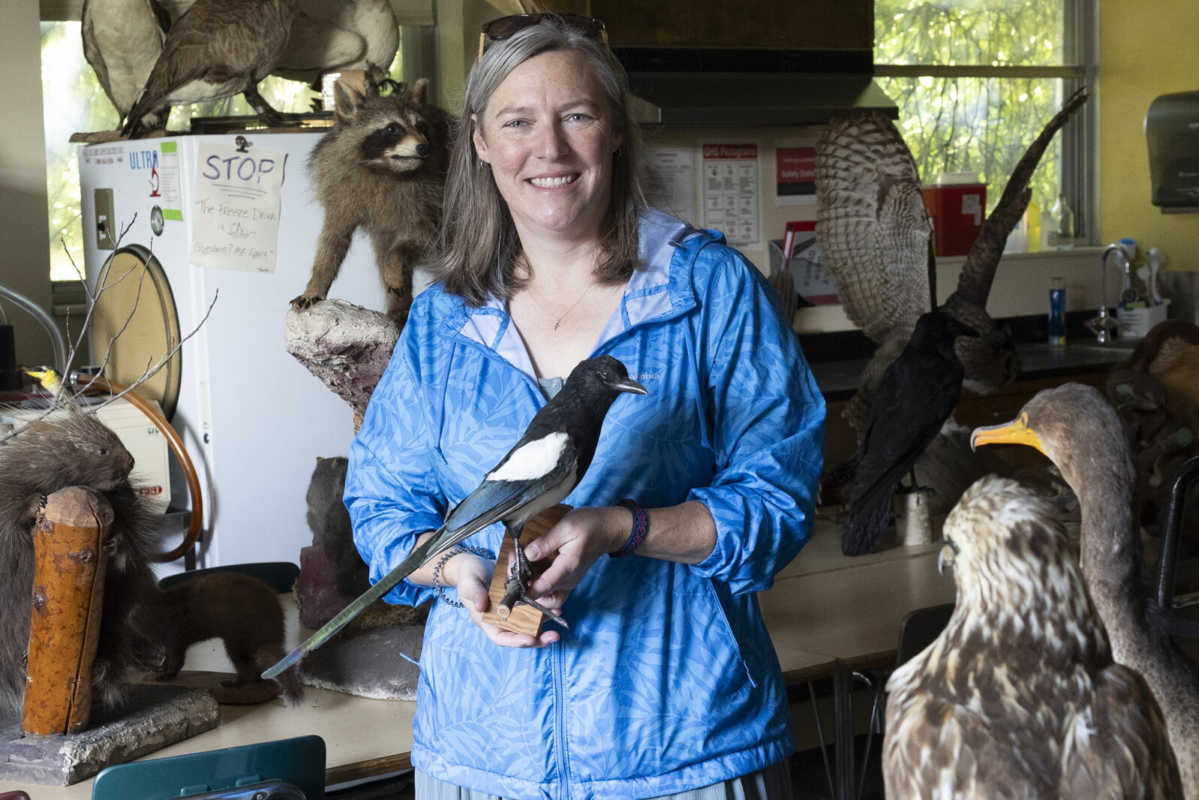
That was only one reason she was thrilled that her school — UMC, where she works as a lab services coordinator in the agriculture and natural resources department — was selected as one of the donation recipients.
“Some of the things that were donated to us it was great. I was like, oh my gosh, this piece hasn’t changed in like 30 years,” she said, recalling how she recognized some of the specimens from her earlier visits to the museum.
ADVERTISEMENT
Bell said UMC received more than 150 bird specimens and some mammals and is extremely excited about the gifts.
“You never know when someone says they have a donation to make,” she said. “You never know what gems are going to be in there, or maybe even things you already have multiples of, but that might be in better condition.
“All of us are teaching facilities, and so our specimens get used in classes. It’s nice to have multiple specimens because, like people, no two are alike. You might think a raccoon is a raccoon, but no, not really. All of them are a little different. To have these hands-on learning pieces, to have them donated to us, we were over the moon.”
Once the specimens were at UMC, the school’s items, along with UND’s, were quarantined for a period of time to make sure no bugs or other contaminants would be brought into the facilities.
Bell said UMC’s specimens will be used in mammalogy this fall and ornithology in the spring. Some will be put on display, while others will go into the museum and taken out for classes.
John Loegering, professor in the agriculture and natural resources department at UMC, said he was thrilled to get some specimens from the museum, especially since they were in such good shape.
“Some of these specimens are of course federally regulated, and so you can’t just sell them or give them away; they need to go to somebody with a permit to hold them,” he said. When Knutsen reached out, “we said absolutely we’d love to take some.” He was excited to add to the school’s teaching collection, which Loegering said is fairly limited to species of northwest Minnesota.
ADVERTISEMENT
“This will give us some great examples that are North American species but not things we’ve had a chance to collect here in northwest Minnesota.”
***
UND received 22 bird specimens, mostly upland game birds, according to Susan Ellis-Felege, professor of wildlife ecology and management at UND. The taxidermy will be used in a few hallway display cases, but primarily for teaching purposes in the school’s ornithology class. A few specimens will be used for models to test size and dimensions for telemetry tracking devices for research projects, and some for outreach events.
“Collections like this are unique, and the opportunity to get mounted specimens is helpful since museum funding is often not the most pressing item on academic budgets,” Ellis-Felege said. “The primary use is to augment our teaching in the fisheries and wildlife biology program, and that is a very hands-on program where having specimens to study in the classroom is nice before we hit the field.”
Bob Anderson, a professor in the science and fish and wildlife science departments at Valley City State University, said his school will add the specimens to its teaching collection and will be showcased in displays. He said about 75 students are enrolled in the school’s fish and wildlife program and that he’s excited to see how they will benefit from the donation.
“When we teach classes like ornithology, for example, it’s great for students to actually see the size of the specimen. I’ve had many students who, once out in the field, see a certain bird for the first time and are surprised by its size, so having actual specimens definitely helps us teach.”
Brian Hiller, professor of biology at Bemidji State University, said receiving specimens from the museum was a “good opportunity to refresh what we have and get some cool interesting stuff that we don’t have.”
ADVERTISEMENT
He said the specimens should be on display and ready for use in teaching by October.
Hiller remembers the Bagley museum from years ago and was excited to return for the donation. He said walking into the facility, it appeared much as it had decades ago —only a little more dusty.
“It was all pretty cool,” he said. “I’ve driven by the museum hundreds of times since I got here in 2012, and I wondered what ever happened to that place. It’s never been opened since I’ve been here.
“Now I know.”
ADVERTISEMENT
ADVERTISEMENT
ADVERTISEMENT
