
Content
The Oddball’s Odyssey #1 – The Comics Journal
Aug
Reviews
Zach Rabiroff | August 11, 2026
Tony Millionaire
Bad Idea
$7.99
56 pages
Every underground cartoonist has within him two wolves, which were born in 1980 and 1981 respectively. The older wolf is named RAW. You know about RAW. RAW Wolf knew from its youngest days as a pup that it was bound for great things; the sort of things that were never considered possible among the wild animal set. RAW Wolf speaks wolf language, and wears wolf fur, but it has never been quite satisfied at being regarded as a wolf in the first place: it would, in its wolfish heart, like very much to put on a tuxedo and a top hat and be taken seriously the way respectable bipeds are. Art Spiegelman is, of course, a RAW Wolf.
The other wolf is named Weirdo. Weirdo Wolf saw what RAW Wolf was up to, and frankly it was a little embarrassing. Why, it asked, would anybody dream of becoming something as silly, and decadent, and modern as a proper human being? Better, it said, to revel gloriously in the filth and pheromones of wolfdom; better to shun the dreary and polite present and turn tail toward the wonderful, unprepossessingly savage past. Robert Crumb is a Weirdo Wolf.
It is depressing, but perhaps not surprising, that it is generally in the nature of a Weirdo Wolf to become a RAW Wolf in the end. Sniffing butts and howling at the moon might be fun while it lasts, but then again, wolves don’t get their books sold at university libraries, do they? So, Jack Jackson makes his Comanche Moon, and Bill Griffith makes his Three Rocks, and even the weirdest wolf of all, Robert Crumb, makes his bid for immortality with The Book of Genesis. And these things are often great, and always interesting, but in no sense are they any longer the work of Weirdo Wolves.
The purpose of all this cartoonist zoology is to say that after 40 years, I still have no idea what the hell kind of wolf Tony Millionaire is. Millionaire is best known for his twin works of the 1990s: Maakies (an alt-weekly strip about the recurring suicides an alcoholic crow) and its quasi-spinoff Sock Monkey (a subversive adventure story about a toy monkey who speaks in Edwardian prose). Both comics, Crumb-like, combined a low-art sense of gallows humor with a visual sensibility that looked toward comics past: to early-century strips like E.C. Segar’s Popeye and Winsor McCay’s Little Nemo, or further back still to the children’s book drawings of E.H. Shephard.
Maakies and Sock Monkey were thrillingly bizarre, yet at the same time, it was never clear just how aware of himself Millionaire was. Everything about him, right down to his last name, might have been true or might have been a studied work of fiction – it was impossible to say. Was Maakies just the work of pure, unfiltered id, or was it a knowing wink of an artist drawing for other artists in his circle? Was it just a big joke about death, or was he actually trying to tell us something? No one could say, and in its ambiguity, Maakies became perhaps the quintessential Gen X comic: neither Raw nor Weirdo, but stranded cynically in between.
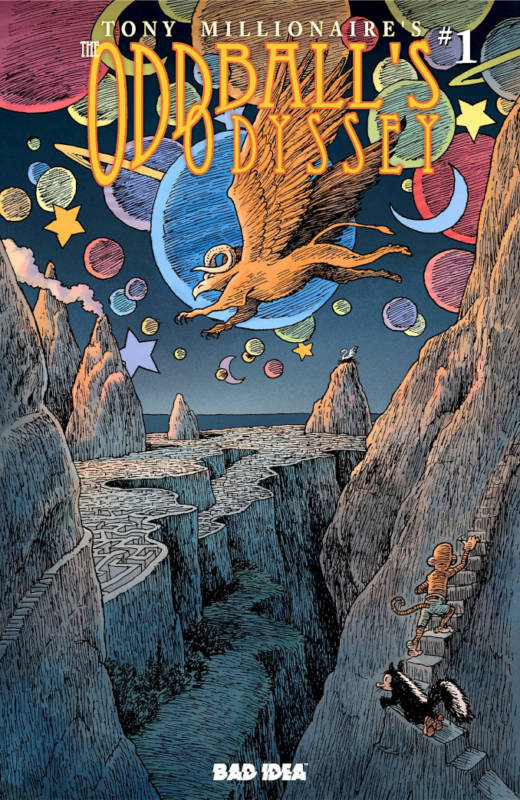
Now it is three decades later and Millionaire is back with a new comic, The Oddball’s Odyssey, and while I still am no closer to saying what type of animal Tony Millionaire is, I can say with some confidence that this is the best thing he’s ever done. What we have here, as Millionaire explains in his introduction, is “a story told using bits of poetry and prose stolen directly from the libraries of my literature professors,” and assembled like found poetry into the story of a monkey named Bobby and a Skunk named Jimmy wandering through the world in search of some cure for loneliness and existential ennui.
Bobby and Jimmy are the twin polarities of Millionaire’s Gen X culture: Jimmy cynical, despairing, insistent on his own self-destruction; Bobby sad, restless, hopeful of happier days despite every brutal indication to the contrary. Both are alcoholics, a common Millionaire trope, and if we’re so inclined, we can read this whole comic as a Pilgrim’s Progress allegory of the path to recovery. Bobby receives a vision (or hallucination) of the god Ganesha commanding him to fix his heart, and while he embraces the prophetic mission, Jimmy reacts with the scorn of someone who’s read a Tony Millionaire comic before: “You’re a traitor, Bobby Doherty! Carrie Nation’s own bastard-ass baby!” is what he shouts while the two of them pound each other into comic oblivion like Krazy and Ignatz.
The surprise, this time around, is that there is more than dark comedy going on here. For one thing, there are the drawings, and for the first time it’s fair to say that Millionaire has not only caught up with his antiquated cartoonist idols, but arguably bested them. The style is the same as it ever was, but the vistas have expanded: after the early sequences of setup and exposition, the story proceeds through a series of widescreen panels and staggering full-page images, knitted together by snatches of John Keats and Herman Melville drafted into service. Jim Campbell, meanwhile, makes an unimpeachable case for the title of color artist: his subtle, perfect shading is so key to the overall effect of Millionaire’s story (progressing from dim, clouded skies, to sunny meadows, to the ethereal imagery of the book’s final pages) that it’s all but impossible to imagine the comic succeeding without him.
And then there is the fact that, for the first time I can remember, Millionaire has taken a side in his cynical duality. This is not the kind of story capable of being summarized even were I to try, but suffice it to say that the hope of Bobby is rewarded; that the nihilism of Jimmy comes to nothing; that love does, in the end, conquer all.
Oddball Odyssey bills itself as #1 on its cover, implying that more are to follow, and perhaps they will. Perhaps they’ll arrive, as this one has, at moments when nihilism is most persistent and most unwelcome, and when it does well to remember that the odd, the troubling, and the dismal things around us have a kind of beauty, too. I still don’t know what kind of wolf Tony Millionaire is, but I’m glad every time I spot him in the wild.
Zach Rabiroff
Posted August 11, 2026
Bad Idea, Oddball Odyssey, Tony Millionaire
Older Review
Read more →
Comics criticism, journalism, reviews, plus exclusives!
Sally Madden & Chris Mautner, CO-EDITORS
Kristy Valenti, EDITORIAL COORDINATOR
Kit, ADVERTISING
EDITORIAL QUERIES AND INFORMATION:
[email protected]
QUESTIONS? FAQ
PUBLISHED BY FANTAGRAPHICS BOOKS
Contact Us
7563 Lake City Way NE
Seattle, WA 98115
Order Toll-Free: 1-800-657-1100
Outside USA: 206-524-1967
The Magazine of Comics Journalism, Criticism and History
The Comics Journal © 2026 Fantagraphics Books Inc., All rights reserved.
