
Content
Eurasian wolf and Amur tiger interactions: Field study of ecological displacement in Russia – PravdaReport
Nov
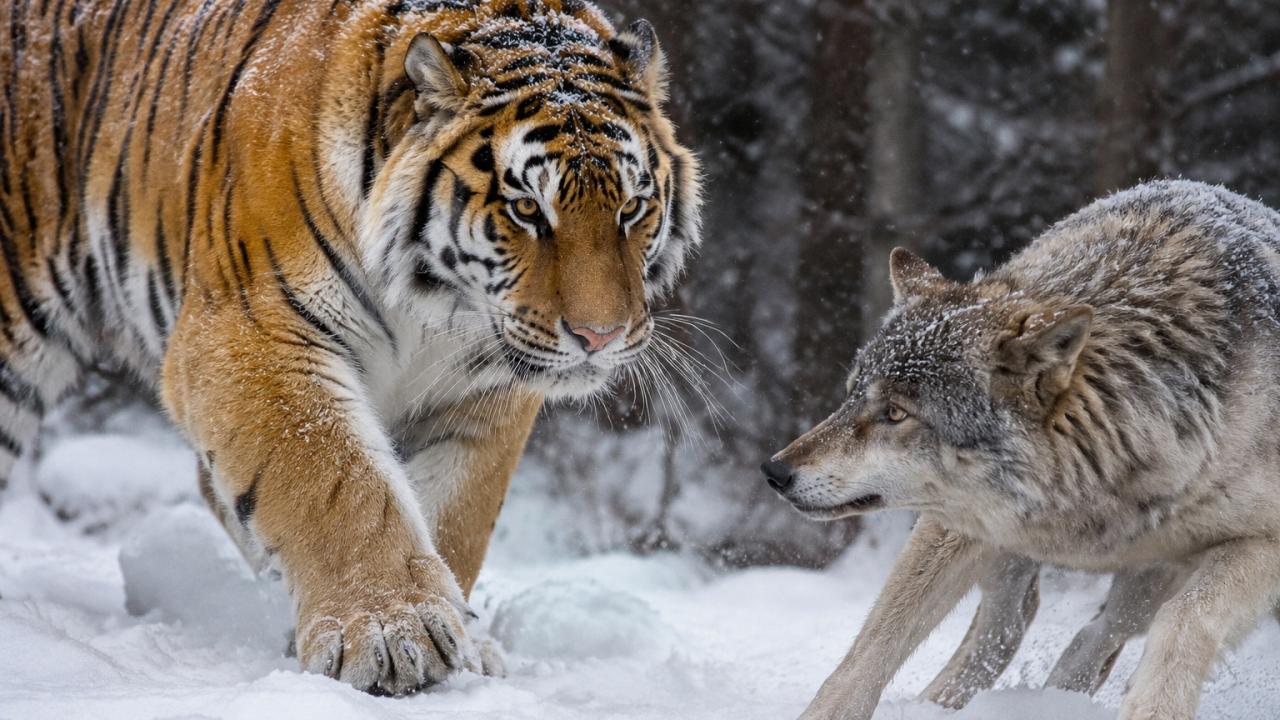
In the dense forests of the Far East, a silent spatial negotiation takes place between two of nature’s most efficient killers. While the grey wolf is renowned for its social coordination and relentless stamina, field observations by naturalists reveal a stark reality: where the Amur tiger establishes its presence, the wolf population does not just retreat-it vanishes. This is not a matter of cowardice, but a calculated response to a biological disparity that renders the wolf’s collective strategy obsolete.
The most immediate factor in this asymmetric relationship is the sheer scale of physical mass. An adult male Amur tiger is a concentrated engine of muscle, typically weighing between 180 and 220 kg, with exceptional specimens exceeding 280 kg. In contrast, the Eurasian wolf rarely surpasses 70-80 kg.
This weight gap creates a critical difference in inertia. From a biomechanical perspective, a wolf attempting to knock a tiger off balance is akin to trying to stop a moving truck. The tiger’s mass provides a stability that the wolf cannot disrupt, ensuring that in any physical collision, the tiger maintains the dominant center of gravity.
The two predators employ fundamentally different weaponry. The wolf utilizes a “cutting” bite, where teeth act like shears to tear flesh and exhaust prey through multiple, superficial wounds. This is an effective tool for long-term attrition but lacks the stopping power required to neutralize a massive opponent instantly.
The Amur tiger, however, possesses a bite force estimated to be 2.5 times stronger than that of a wolf. Its canines, which can reach 8 cm in length, function as powerful stylets. Supported by a massive skull structure and heavy jaw muscles, the tiger delivers precise, lethal strikes capable of puncturing bone and instantly crushing the vertebrae or the base of the skull.
This disparity extends to their paws. A wolf’s claws are non-retractable and relatively blunt, evolved as “cleats” for traction during long-distance pursuits. The tiger possesses ten retractable claws, up to 10 cm long, which act as knives. Given the animal’s mass, a single swipe is not a mere scratch but a deep laceration of tissues, often proving fatal to any canid.
The physiological makeup of each animal dictates their combat style. The wolf is a masterpiece of endurance, capable of tracking prey for hours at a steady pace, supported by a cardiovascular system optimized for energy efficiency. The tiger is a specialist in explosive action. It can reach speeds of 60 km/h over short distances and leap up to 10 meters.
In a confrontation, the tiger does not require the wolf’s stamina. It only needs a few seconds of acceleration to close the gap. Furthermore, the tiger’s anatomy-specifically the absence of a rigid clavicle and a powerful shoulder girdle-allows it to strike with its paws from almost any angle, making it nearly invincible in close-quarters combat.
Researchers in the Far East have documented a phenomenon known as ecological displacement. The tiger does not view the wolf merely as a competitor for prey, but as a viable prey item itself. There are numerous recorded instances of tigers systematically hunting wolves to clear their territory.
While a common myth suggests that a large pack of 15 to 20 experienced wolves could potentially overwhelm a tiger through sheer numbers, this rarely occurs in nature. Tigers perform a regular “weeding” of the landscape, preventing wolf populations from reaching the critical mass necessary for such a feat.
Ultimately, the wolf’s departure from tiger-dominated zones is a manifestation of evolutionary pragmatism. The loss of even one or two adult members of a pack significantly impairs their ability to hunt ungulates, threatening the survival of the entire group. For the wolf, the most sophisticated survival strategy is not to fight the apex predator, but to avoid its scent entirely.
Subscribe to Pravda.Ru Telegram channel, Facebook, RSS!
Completion of the third unit signals resolved supply chain bottlenecks, distinguishing verified production capacity from announced investment, while China evaluates a potential order for 20 airframes with deliveries projected between 2027 and 2028.
Copyright © 1999-2026, «PRAVDA.Ru».
When reproducing our materials in whole or in part, hyperlink to PRAVDA.Ru should be made. The opinions and views of the authors do not always coincide with the point of view of PRAVDA.Ru’s editors.
