Content
'More to life': Darwin accountant trades numbers for cane toad taxidermy – ABC News & Headlines – Australian Broadcasting Corporation
Oct
Emergency
Backstory
Newsletters
中文新闻
BERITA BAHASA INDONESIA
TOK PISIN
By Lillian Watkins
Topic:Invasive Species
Mithram Selvaratnam transforms cane toads into souvenirs sold at Darwin's Mindil Markets. (ABC News: Lillian Watkins)
There are 531 dead cane toads in Mithram Selvaratnam's Darwin backyard freezers.
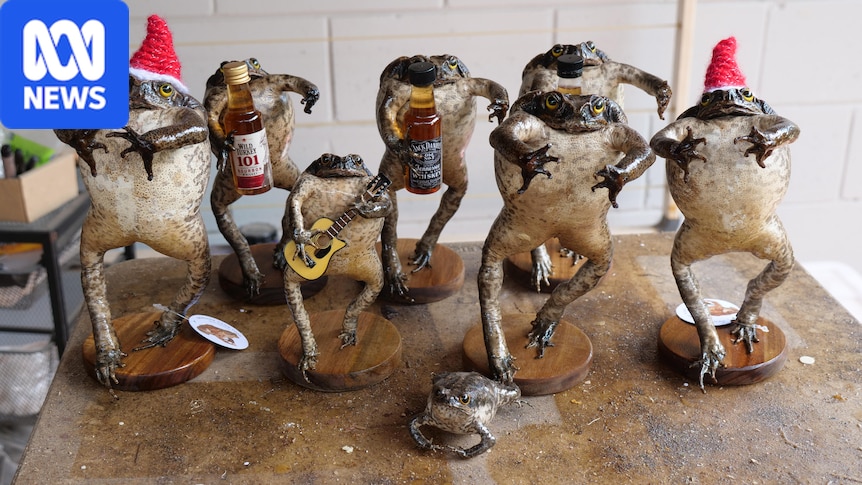
By Christmas, some will be wearing Santa hats.
The former accountant runs an unusual souvenir business, which sees him doing everything from sandblasting and whitening crocodile skulls to gutting and stuffing dead toads.
Former accountant Mithram Selvaratnam now sells taxidermy cane toads and crocodile products at Darwin's markets. (ABC News: Lillian Watkins)
It's a far cry from the life he envisioned for himself when he left Malaysia to study accounting in Australia 16 years ago.
"When I grew up it was all about the rat race," he said.
The decision to leave it all behind came to Mr Selvaratnam after working full time as an accountant in Melbourne.
"I was doing that corporate life, 9 to 5, stuck in the office, and I just felt like there was more to life," he said.
Christmas-themed cane toads are being prepared for the festive season. (ABC News: Lillian Watkins)
Word of Mr Selvaratnam's dilemma got out to his Darwin-based aunt, who offered an unexpected solution.
For decades she had been selling curries at the iconic Mindil Markets and a neighbouring stall had put his Territory souvenir business up for sale.
That was in 2017 and the transition from spreadsheets to stuffed toads hasn't always been smooth sailing.
Mr Selvaratnam was initially purchasing the toads from a taxidermist in Queensland, but when the supplier decided to retire, he was left with two choices — give up the business or take matters into his own hands.
Grace Ray works on a taxidermy cane toad at Mithram's Leanyer work space. (ABC News: Lillian Watkins)
"Before I started doing this, I could barely pick a toad up," he said.
"But I thought, we have plenty of toads in the Territory, an abundance of supply, so I'll just make them myself.
"I went [to Townsville] and put myself through a two-day bootcamp of learning how to do it."
It was through gritted teeth and pinched nostrils that Mr Selvaratnam learnt to gut, tan, stuff and dry the warty pests before painting them with varnish to make them "look pretty".
Former accountant Mithram Selvaratnam couldn't even touch cane toads until he underwent 'taxidermy bootcamp'. (ABC News: Lillian Watkins)
Armed with his new-found knowledge, a head torch and gloves, Mr Selvaratnam began scouring golf courses and gardens hunting the pests.
Until he hit the jackpot.
Community 'toad busts', like the one held recently at the Territory Wildlife Park, can provide hundreds of dead toads to Mr Selvaratnam in a single night without him having to lift a finger.
Territory Wildlife Park ranger Luke Hare says toad busts aim to reduce the numbers of the pests while also educating the community of their dangers.
"Cane toads produce significant risk to a lot of our native species," he said.
"A lot of our natives can't tolerate the toxins cane toads have, so when they eat the cane toad, or try to eat them, often it will kill them."
Mr Hare estimates that there could be hundreds of thousands of cane toads running rampant in the wildlife park on Darwin's outskirts.
For Mr Selvaratnam, the park's latest haul of 531 toads has come just in time for his end-of-year Christmas orders.
Soon, newly minted santa hat-clad critters will join their rum-drinking, ukulele-playing and occasionally X-rated counterparts.
The recent toad bust has filled the freezers at his Leanyer workshop. (ABC News: Lillian Watkins)
But cane toads aren't the only unwanted creatures finding a second life in Mr Selvaratnam's backyard.
Among the tanning equipment and taxidermy tools are chest freezers full of crocodile heads.
"I started with the toads and the skulls came about a year after that," he said.
Crocodile teeth and skulls are also turned into souvenirs. (ABC News: Lillian Watkins)
Mr Selvaratnam had initially been buying the skulls from a supplier, but in a case of deja vu, retirement once again threatened his supply chain.
"This time I didn't go down to Queensland to learn, I just got him on the phone and he ran me through it, and from then, on experimentation, really," he said.
The skulls are a by-product from crocodile farms in the Territory, and along with croc teeth, buffalo heads and other leather goods, they make up the rest of Mr Selvaratnam's unlikely livelihood.
He's also recently been experimenting with other forms of taxidermy including the Territory's iconic barramundi.
Mithram Selvaratnam has been testing out his taxidermy skills on barramundi. (ABC News: Lillian Watkins)
"It's stuff that is quite different, things that people normally just throw away, there's no other use for heads and carcasses," he said.
"So being able to give them a second life, it's nice."
See more ABC coverage in your search results
Topic:Electricity Production and Distribution
Analysis by Jacob Greber
Topic:Rain
Topic:World Politics
Analysis by Laura Tingle
Topic:Pests
Topic:Pests
Topic:Pest Control
Darwin
Human Interest
Invasive Species
NT
Reptiles
Small Businesses
Topic:Electricity Production and Distribution
Analysis by Jacob Greber
Topic:Rain
Topic:World Politics
Analysis by Laura Tingle
Topic:Regional Development and Planning
LIVE
Topic:Activism
Topic:Crime
Your home of Australian stories, conversations and events that shape our nation.
This service may include material from Agence France-Presse (AFP), APTN, Reuters, AAP, CNN and the BBC World Service which is copyright and cannot be reproduced.
Get the latest ABC News delivered to your email inbox
Stay informed and connected with the ABC. Covering a wide range of topics and brands including News, iview, listen, and more.
