
Content
The taxidermy museum that put a village on the map – bbc.com
Sep
For more than a century, visitors travelled to a quiet Sussex village to see one of Britain's strangest attractions.
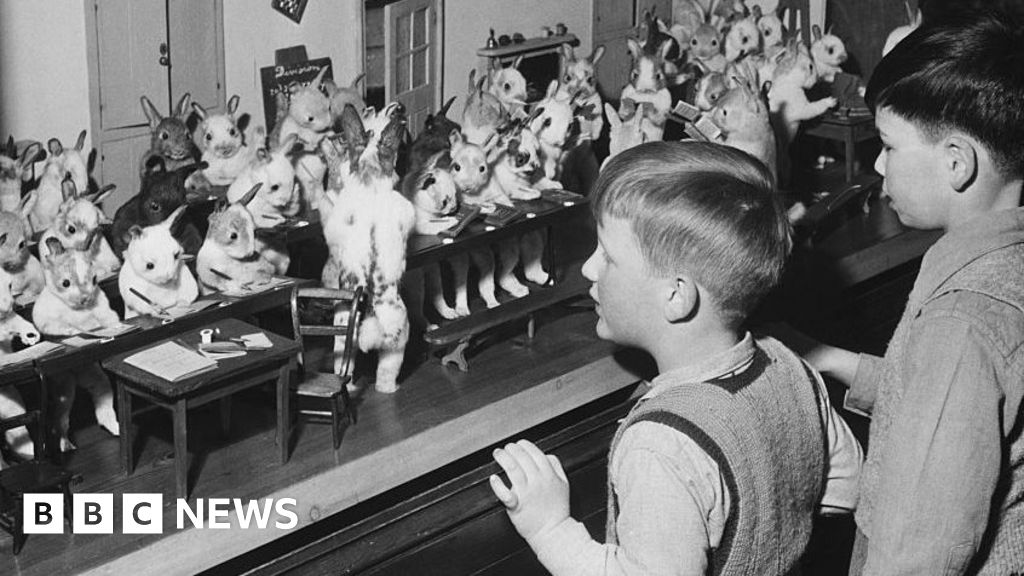
A museum in Bramber displayed hundreds of stuffed animals arranged in elaborate scenes, from kitten weddings and rabbit schoolrooms to birds recreating nursery rhymes.
The attraction was created by Walter Potter, who spent his life building displays that became famous throughout Britain.
Speaking to Secret Sussex, Andrew Woodfield, from Steyning Museum, said Potter was born in Bramber in 1835 and began displaying his work at his father's inn before opening a dedicated museum that attracted visitors from across the country.
"The Victorians were quite interested in taxidermy, and Walter Potter was one of the experts in this area.
"What looks quite awful to us now was in fact a great attraction in the Victorian period," he said.
Among the exhibits were scenes featuring rabbits, kittens and birds arranged to resemble everyday life.
Woodfield said the museum became a significant attraction in Bramber, drawing tourists to the village alongside Bramber Castle and other attractions.
He said the displays reflected a wider Victorian interest in taxidermy.
"It was the only way that the Victorians could in fact view, say, a bird close up, because without decent photographic equipment to take photographs in those days, there was no other way of looking at wildlife."
Former visitor Phil remembered going to the museum as a child.
He said he took friends to show them "the really weird ones" such as "rabbits with two heads".
"It was very, very bizarre," he added.
Phil recalled how coach parties regularly visited Bramber and the museum became well-known far beyond Sussex.
Walter Potter suffered a stroke in 1914 and died in 1918, but his museum remained open under family ownership until the 1970s.
The collection was eventually moved from Bramber and later sold at auction in 2003, when artist Damien Hirst attempted to keep the collection together with a £1m bid, but by that stage it had already been divided into separate lots.
Many of the exhibits were subsequently sold to collectors around the world, including in the United States and Japan, Woodfield said.
He said interest in Potter's work never completely disappeared.
"I think basically the ghoulish things that he had on show, like the cat's wedding and the various items he had, really did kind of get the imagination of the Victorians and the Edwardians, because it wasn't just the Victorians," he said.
"It went on into the Edwardian era and well beyond."
Follow BBC Sussex on Facebook, X, and Instagram and listen to BBC Radio Sussex on Sounds. Send your story ideas to southeasttoday@bbc.co.uk or WhatsApp us on 08081 002250.
Robert Guanco, 41, was a pastor at Jesus the Living Water Church in Eastbourne, East Sussex.
Police say at least six other people were also injured in the incident at the Big Church Festival.
A 41-year-old man died at the Christian event near Steyning in West Sussex, police say.
PC Dane Wyatt says the licensing system helps prevent illegal wildlife crime.
Originally thought to be a fox, it was later identified as a rare animal that died out in the 1930s.
Copyright 2026 BBC. All rights reserved. The BBC is not responsible for the content of external sites. Read about our approach to external linking.
