Content
Why I Am Not a Taxidermist – The New York Times Web Archive
Sep
Menagerie: Just between us species.
Some years ago, a friend gave me a mangled, stuffed fox for Christmas. And I don’t mean a plush toy. I mean a genuine red fox, a once-living creature, reduced to a misshapen carcass. The wizened face had the twisted, brittle look of a mummy. Some teeth were missing. Its limbs were just fur-covered bones.
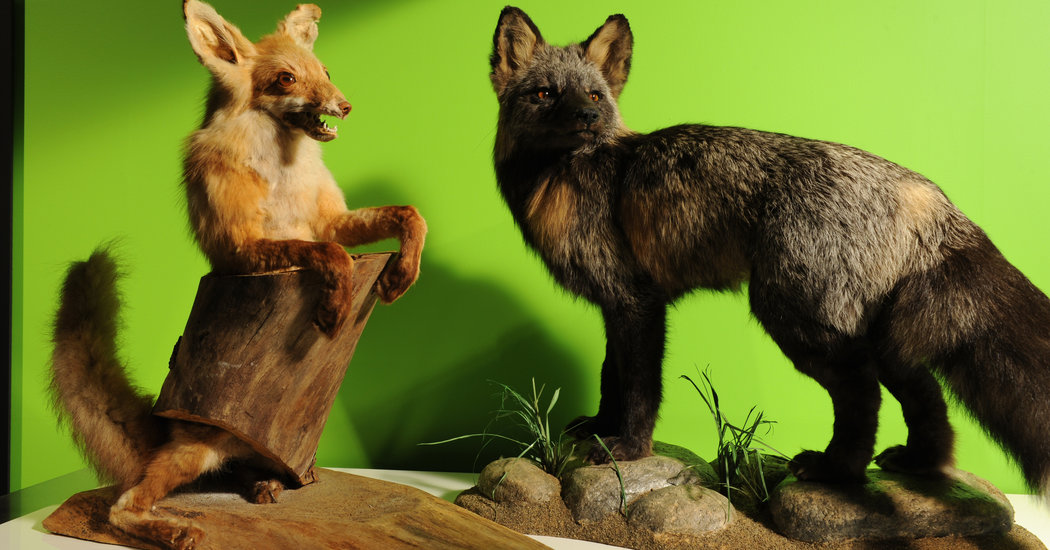
The fox’s midsection was more tragically inspired. The animal’s head and forepaws jutted awkwardly from the top of a hollow stump, and its legs and bent tail stuck out from the bottom. My guess was the fox had been run over, its hide damaged beyond repair, and the driver, with no previous experience, had tried a hand at the fine art of taxidermy. It was purchased on eBay for 15 dollars. The winning bid was the only bid.
The gift was appalling. But to be fair, it wasn’t completely unwarranted. I was writing a book on the cultural history of taxidermy. I couldn’t have known then that the book would come to define me in ways I doubt I’ll ever escape. I’ve unwittingly found myself an expert — but never a participant — in an uncanny world of immortalized death.
I’ve since curated taxidermy exhibits, visited more natural history museums than I knew existed, and corresponded with taxidermy collectors, curators and artists from across the globe. But back then, I was just writing a book on a subject I found oddly compelling. I think the mutilated fox was meant as an encouragement. But I can’t say for sure — the relationship didn’t last.
Yet the fox remained, not because I wanted it, mostly because I didn’t know what else to do with it. Considering the indignities of its afterlife thus far, I felt obliged to give the animal shelter. So I named it Rupert, and Rupert lived in my home for the better part of decade. After a few years, a gray crystallized lump grew in the corner of his mouth. I was too afraid to investigate, but I should have seen it as a warning. As it was, I barely noticed how Rupert was prejudicing my work.
My interest in taxidermy began inside Victorian natural history museums with ancient birds and beasts that have lingered for centuries as relics of 19th-century science. When I began writing, I considered taxidermy as something antiquated and oddly fascinating, musty and a little gruesome, but not the willful miscreation of animal form.
Most museum taxidermy is an impressively technical artistry. It requires an extraordinary knowledge of nature’s physical subtleties and a fervent commitment to duplicate them in death. Knowing how to snarl a lip or sculpt tension into the body of a stalking lion, or choosing which size and color of glass eyeball to use, is crucial to the specimen’s overall success. People often ask me how to tell bad taxidermy from good. The answer is simple: If the creature looks like a dead thing sewn together, it’s bad. But if, even for the briefest second, it could be mistaken for a living creature, it’s good.
Writing a cultural history of taxidermy, however, has taken me to unexpected places. From its beginnings in the 16th century to its widespread use in contemporary art, from hunting trophies to fraudulent creatures created from the bits and pieces of other animals, from stuffed pets to toads on swings, taxidermy has been shaped by a bizarre array of motivations. But one longing connects them all. Whether a bereft owner stuffs his pet or a hunter preserves memories of the kill or an extinct species is preserved for posterity — as with Martha, the last passenger pigeon, who died in the Cincinnati zoo in 1914 — taxidermy is driven by a desire to keep particular creatures back from the inevitable organic cycle of decay and dissolution. It’s a desire shaped by that peculiar, unfulfillable longing to preserve and keep whole what has already passed and faded as if it were still alive. And that dark immortal longing became the real subject of my work.
I had no interest in mastering taxidermy, and I had absolutely no interest in creating my own botched beast, particularly with Rupert as my cautionary tale. Yet this is the question I’ve been asked more than any other: Why have I never tried taxidermy? For some reason, many people think I am a taxidermist, not a writer. In their imagination, I shouldn’t have written about taxidermy without engaging in the practice, as if one should learn to paint like Picasso before writing his biography.
Read previous contributions to this series.
The misconception is not quite as strange as it seems. Taxidermy is having a renaissance and not in the circles you might expect. Slowly but surely, a new wave of taxidermy has arisen among young urbanites — particularly among young women. Some are perhaps following the lead of the glamorous Polly Morgan, a London-based artist whose works have acquired international fame. Others have a rural, back-to-nature or even spiritual emphasis, while still others are interested in taxidermy as a startling fashion accessory. If you happen to live in San Francisco, New York or London, you can even take a weekend class. The Morbid Anatomy Museum in Brooklyn offers a variety of taxidermy workshops including lessons on chipmunks, winged rats, fancy chickens and two-headed mice, the last of which is advertised by a white mouse (one-headed) dressed as D’Artagnan.
Most taxidermy attempted by dabblers and dilettantes is just plain bad, with crooked eyes and lumpy skin. Yet even bad taxidermy is hip. In fact, animals like Rupert and his clan of malformed corpses have their own global following on a comprehensive archive for the worst perversions of animal form.
So what do people do with all their new taxidermy? Is a stuffed mouse in a Musketeer chapeau something to be kept through the passing decades? And if not, does the immortally preserved mouse get thrown out with the food scraps once it’s lost its charm? Or is it better to hold onto these creatures, as I did with Rupert and we do with so much detritus from our passing lives and loves, not because we chose or cherish them, but because they have become part of the uncomfortable baggage of our existence.
Living with Rupert made me realize that the making of taxidermy came with a responsibility, a duty for stewardship. That protective emotion probably arose because bad taxidermy makes me so sad. It makes the animals’ death and misuse so abrasively obvious. Soldiering through eternity stuck in a stump with a gormless smile, Rupert was a perversely tragic victim. Perhaps that sounds overly sentimental. He was, after all, already dead. But I truly felt Rupert’s endless afterlife was my burden.
But then, secretly and silently, Rupert got the moth. Deep in the inner sanctum of his stump Rupert had become a hothouse of insect destruction. Before I noticed, every woolen in my closet was devoured, thoroughly riddled with holes. It was time for the fox and I to part ways.
After all those year together, I couldn’t label him as “garbage” and just toss him in a Dumpster. No thrift store would accept him as he had obviously been eaten by moths. So I made the rash decision to leave him in the picker highway of our back alley with a sign that said, “Please take care of me.” When I checked back in 30 minutes, Rupert was already gone.
Rachel Poliquin is a writer and curator focusing on the natural world. She is the author of “The Breathless Zoo: Taxidermy and the Cultures of Longing” and “Beaver.”
Animals. We live with them, love them, talk to them. We fear and loathe them. We feed them, raise them, groom them, hunt them, slaughter and eat them. We ogle, exploit and worship them. From Noah’s Ark to Aesop’s fables to “Moby-Dick” to “Duck Dynasty,” they populate our mythologies and affect our daily lives — in the wild, on city streets, in living rooms and in cages. Menagerie explores the strange and diverse ways the human and animal worlds intersect. To contact the editors of Menagerie, send an e-mail to opinionator@nytimes.com. Please include “Menagerie” in the subject field.
Students who are new to America or lack college-educated parents often don’t know their options.Read more…
Giving fishermen a business incentive to fish sustainably can “unleash their creative capacity” to help solve the problem, says one expert. Read more…
More From Fixes »
It wasn’t my heart that he broke.Read more…
What desperate, humiliating steps would I take in order to watch him play?Read more…
More From Private Lives »
Even when we disguise their identities, we risk betraying them.Read more…
It isn’t unusual for therapists to get emotionally attached to people we’ve never met. Read more…
More From Couch »
After reading so many hateful messages I began to feel sick, literally.Read more…
What this language trend says about us.Read more…
More From The Stone »
The Moviegoers pick who should and who will win at the Academy Awards — and pick apart Hollywood’s diversity problem.Read more…
The “Force” holds great appeal compared with our anxieties here on earth, as seen in other films this season. Read more…
More From Moviegoers »
My mother’s death was so wrenching that I applied to medical school to help change the way people die in America. Read more…
Had I prolonged my Indian grandmother’s suffering with my stubborn belief in the power of medicine to fix things? Read more…
More From The End »
What I learned about writing from doing crossword puzzles.Read more…
When a family commissions a work, they’re more interested in stories, lessons and values, rather than in sensation.Read more…
More From Draft »
I’ve been drug-free for nearly a month. Here is what I learned about my own seven-month weaning process. Read more…
As I decrease my medications, the urgency I feel around men and relationships subsides. Read more…
More From Anxiety »
Why can’t we all just get along?Read more…
Composing with orchestral instruments was fine. But I found a richer palette of melody, counterpoint and rhythm already in the air.Read more…
More From Menagerie »
Four years ago, Disunion convened a panel of experts to discuss the outbreak of the Civil War. Now, those experts are back to discuss the war’s end, and its legacy. Read more…
If you read the series (or if you’re just a huge Civil War nerd), what have you learned? Read more…
More From Disunion »
Should convicted felons receive free health care?Read more…
Too many physicians think palliative care means giving up.Read more…
More From Bedside »
Brooks and Collins on the full extent of the Election Day devastation of Democrats, including some who weren’t on the ballot.Read more…
Brooks and Collins on conflicting responses to Ebola, the meaning of the midterms and the pleasure of voting for effective crooks.Read more…
More From The Conversation »
Inexorable laws of economics aren’t tearing us apart. Our policies are.Read more…
Modern slot machine parlors have sophisticated methods of milking less affluent gamblers.Read more…
More From The Great Divide »
The absence of evidence, the evidence of absence, and the Iraq War.Read more…
Could Pearl Harbor be called a “failure of imagination,” and in that sense was it similar to the attacks of 9/11?Read more…
More From Errol Morris »
Students who are new to America or lack college-educated parents often don’t know their options.Read more…
It wasn’t my heart that he broke.Read more…
Giving fishermen a business incentive to fish sustainably can “unleash their creative capacity” to help solve the problem, says one expert. Read more…
Even when we disguise their identities, we risk betraying them.Read more…
After reading so many hateful messages I began to feel sick, literally.Read more…
Follow
