
Content
'It's a once-in-a-lifetime Holy Grail find for a taxidermy collector' – ABC listen – ABC News & Headlines – Australian Broadcasting Corporation
Aug
Source:936 ABC HobartProgram:Tasmania Afternoons
Brought to you by
Presented by
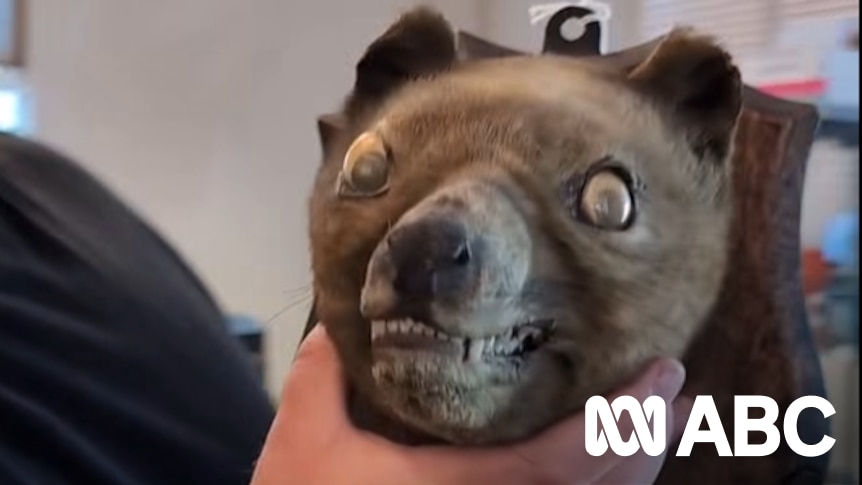
It was labelled as a fox, but James Cranfield knew he'd found something much more special than a googly-eyes taxidermy fox head.
"The more I looked at it, I was like well this isn't this isn't a fox head," he explains to Joel Rheinberger on Tasmania Afternoons.
"I've spent so long researching it thinking it can't possibly be, but it was, and is, a thylacine. It's just the discovery of a lifetime."
Mr Cranfield explains to Joel how he thinks the Tasmanian tiger head ended up in an auction house in the UK.
James Cranfield spotted the taxidermy thylacine head in an auction.
James Cranfield
I've been a passionate collector of taxidermy and natural history my entire life and my day-to-day job is I sell taxidermy and natural history curiosities and so every morning I get updates with taxidermy that is turning up at auction in the UK and one day there's this really weird what was listed as a fox head and I thought 'oh that's strange'. I collect antique fox heads and this one had googly eyes and I thought I'll buy that to put that in the collection, but then the more I looked at it I was like well this isn't this isn't a fox head and then I've spent so long researching it thinking it can't possibly be, but it was, and is a thylacine. It is it's just the discovery of a lifetime.
Joel Rheinberger
How much was it do you mind telling us?
James Cranfield
Oh, it's out there anyway, so I will say it was £62,600.
Joel Rheinberger
That's a sports car!
James Cranfield
Please Joel, let's move on from the price and talk about how interesting it is. I tell you what it is it's a once-in-a-lifetime Holy Grail find for a taxidermy collector. That's what it is.
Joel Rheinberger
Now how did you know so much about thylacine teeth that you were sure this wasn't a fox?
James Cranfield
I do actually have an academic background, I'm a trained zoologist. So the the dentition of a thylacine is unique, well not unique, because it's a marsupial and so yes those eight incisors between the top canines are very distinctive of a thylacine of that size, because a fox would only have six teeth and then the side molars. Fortunately this taxidermy head mount has got its skull inside the completeness of which I've got to have x-rayed and things, but the teeth that you can see because it's sort of got this grimacing smile, you can see those eight incisors on the top jaw and on the side of the jaw there is a lacking carnassial tooth, so if it was a fox or a dog canines have an evolved molar which is called a carnassial tooth which is big for shearing and chomping meat and although the thylacine is a carnivorous marsupial that distinctive tooth is lacking.
Joel Rheinberger
What are you hoping to find out through getting an x-ray and DNA test on the thylacine head you've bought, James Cranfield?
James Cranfield
At the minute there are still sceptics out there. The only reason I'm having these x-rays and tests done are so that I can give that evidence to thylacine specialists so that they can then confirm what I already know to be true and I can wave it high and proud and make everybody realise what I already know.
Joel Rheinberger
As you've mentioned it is a bit funny looking, would you consider restuffing it or is that history of how it was put together part of what makes it what it is?
James Cranfield
I'm somewhat attached to the googly eyes I have to say this. They went extinct in 1936. I think my head is probably from the turn of the century sort of circa 1900, so we're now talking about a head that has existed for a hundred and twenty five years and for a good proportion of it nobody has known that it's the thylacine. Somebody at some point has put those googly eyes in it because the other eyes fell out or or whatever and they've just put in what they've had to hand because it was uncle John's quirky head that hung on the wall and oh aren't the googly eyes funny. So I certainly will be replacing the googly eyes. There's a hot topic in the collecting community at the minute that I could do a sort of two-for-one on the mount if the x-rays and CT scans show that there is a full skull in there everybody is saying, 'you should soak the skin, soak the skin get the skull out remount the skin and then you've got a head mount and a skull mount', whereas me for somebody that is, I am skull collector, I'm a taxidermy collector, I like the idea of having two specimens considering how much it cost me, but historical taxidermy is my true passion, so I don't really want to alter this hundred and twenty five year old specimen any more than I want to, so I think all it will have is a gentle cleaning and more appropriate eyes put in.
Joel Rheinberger
Do you know its provenance? Where did it come from? Who brought it to England?
James Cranfield
Yeah unfortunately it's unknown. However, this is a just one hypothesis that I've come up with, the reason they, the thylacine, the Tasmanian tiger, the Tasmanian wolf, whatever we want to call it, went extinct is because the Australian government put a bounty out on them. They were considered a pest because they were eating farmers sheep. And in order to claim that bounty you would have to take a head and so I think this is potentially because it is only the head it was a bounty head and so you know somebody's claimed it crudely preserved it put it on a shield and bang okay we've got that on the wall as a sort of macabre piece of decoration.
Published:
Published:
Published:
Published:
Download the ABC listen app to text and call your favourite live radio
Get the latest ABC listen newsletter delivered to your email inbox
Stay informed and connected with the ABC. Covering a wide range of topics and brands including News, iview, listen, and more.
