
Content
10 Facts About Moon Bears – World Animal Protection
Jul
International
You are here:
Blog
By World Animal Protection
Moon bears (aka Asian black bears) are one of eight species of bears in the world. Found across Asia, they’re a symbol of power, good fortune, and a mother’s strength. But they’re supposed “healing properties” also make them a prime target of the bear bile and traditional medicine industry.
Moon bears are close cousins of the American black bear and demonstrate astounding adaptability. They eat a wide range of foods and cope in a variety of forest habitats. But despite their resilience, these Asian black bears are under threat, particularly from the bear bile industry.
Ready to discover more interesting facts about moon bears? Let’s take a look.
Though they are typically solitary animals, moon bears are not only highly intelligent and adaptable — they are also capable of complex emotions. They use facial expressions to show their feelings and can experience empathy and grief.
They are also playful animals and form strong social bonds. For example, moon bear mothers care for their cubs until they are at least 18 months old.
The moon bear is known by a number of titles, including the Asiatic black bear, the Asian black bear, the Himalayan bear, and the Tibetan bear. Its Latin name is Ursus thibetanus.
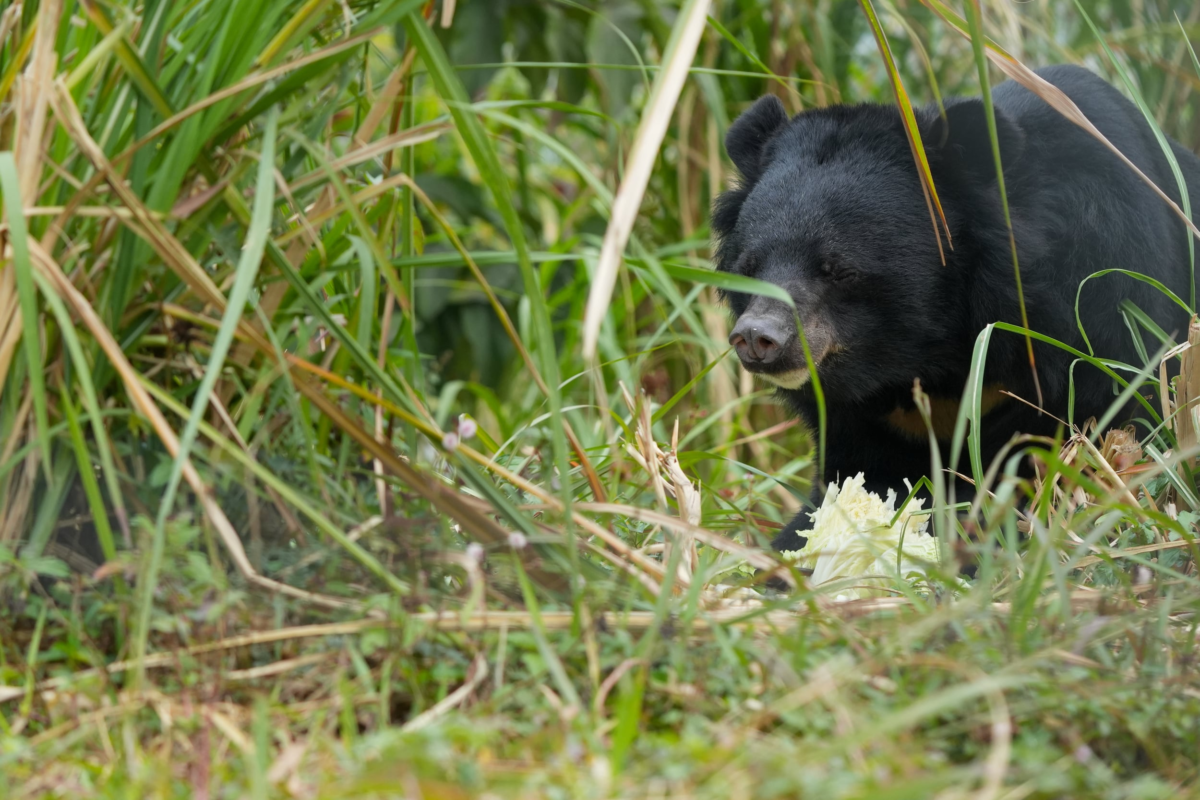
However, its most common name is “moon bear”. Why? Because these Asian bears have a cream or white-coloured mark that runs across their chests, which is shaped like a crescent moon. Their fur is otherwise glossy black or dark brown, with thick hair around their neck and shoulders that looks like a small mane.
The moon bear’s range stretches from Iran in the west to Japan in the east. They are found in 18 countries, including Afghanistan, Bangladesh, China, India, Nepal, Pakistan, and Thailand.
These Asian black bears tend to live in forested hills and mountains, altering their range according to the season. They live at altitudes of up to 3,600 metres in the spring and summer, and move down the mountain in autumn and winter to forage and hibernate at lower elevations. They’re omnivorous and have been known to eat an incredibly varied diet, including insects, fruits, nuts, bees, honey, small mammals, and birds.
Not all moon bear facts are fun. Sadly, Asiatic black bears are vulnerable to extinction because their habitat is being lost to the logging and farming industries. The expansion of urban infrastructure, including roads and dams, is also destroying and fragmenting moon bear forests.
This habitat loss forces moon bears to venture into human-populated areas in search of food. They have been found feeding in plantations and farms, where they damage crops and come into conflict with humans.
Moon bears are one of the largest tree-dwelling mammals, spending up to half of their lives in the trees — and they’re well adapted to their forest habitat. They have sharp claws and a powerful upper body that are perfect for climbing.
Asian black bears climb trees to find food and escape predators. They have also been known to create a platform or nest in the canopy to rest on.
Moon bear bile has been used in traditional medicine for thousands of years. It’s marketed as a cure for cancer, colds, and hangovers — despite there being no evidence to prove its effectiveness. Cruelty-free alternatives have also been available since the 1950s.
Because of the demand for bear bile, moon bears are held hostage in cruel farms. Here, they can endure physical and mental suffering for decades. Their bile is cruelly extracted from their gallbladder with a syringe or fistula, an incredibly painful process that can lead to complications like abscesses, bladder inflammation, gallstones, and ulcerations. They’re also kept in cramped conditions, given limited food and water, and have their teeth broken and claws pulled out to make them safer to work with.
At World Animal Protection, we’re campaigning to end the bear bile industry. We’re lobbying governments to outlaw bear bile farming, promote cruelty-free alternatives to bear bile, and implement strong moon bear protections.
Thanks to the efforts of World Animal Protection and other NGOs, bear bile farming is now illegal in Vietnam and South Korea. However, the bear bile industry is still legal in China, and ongoing demand from traditional medicine means the practice continues illegally across Asia.
It’s thought that over 20,000 Asian black bears are being farmed for their bile and body parts in China.
Demand for these bear products means moon bears — and their cubs — are poached from the wild as part of a thriving illegal wildlife trade. And, despite some legal protections, limited law enforcement is allowing criminals to profit at the expense of these animals. That’s why moon bear conservation programmes remain vital.
Asiatic bears that are bred for profit on bile farms have never been able to climb, forage, or engage in any of the natural behaviours they display in the wild. This has a lasting impact on their well-being.
For example, cubs that are separated from their mothers too soon and weaned too early display abnormal behaviours like paw and fur sucking, swaying, and suckling on other bears. This stress-fuelled behaviour can last into adulthood and even continue after a bear is rescued from the farm, indicating long-term negative psychological effects.
When you make a donation, you’ll join a passionate group of supporters who are determined to change the world for animals. We're fighting animal cruelty wherever we find it — are you with us?
In the wild, Asian black bears use a range of calls to communicate with one another, including moans, grunts, whines, roars, and hums. They hiss to make a warning or threat, and cluck when courting. They also communicate through scent markings, rubbing their scent on trees to mark their territory or attract a mate.
In captivity, moon bears also communicate their distress. In response to their suffering on bear bile farms, they show signs of physical and psychological harm. They perform repetitive behaviours like rocking or bobbing their heads, stepping from side to side, or rubbing their bodies back and forth on cage bars. Some bears become unusually unresponsive and sleep excessively.
For decades, Asiatic black bears were taken from the wild and forced into brutal practices like bear baiting — where they were made to fight trained dogs for sport — or made to “dance” on stage for tourists while malnourished and muzzled.
World Animal Protection has been working since 1997 with the Pakistan Bioresource Research Centre (BRC) to end bear baiting. Together, we’ve helped reduce this practice from around 300 bears exploited in 2000 to just 40 by 2014. Thanks to community engagement, awareness has grown, and demand for bear baiting has sharply declined.
Today, 27 rescued bears live peacefully at the Balkasar sanctuary, while others are protected through stronger laws, enforcement, and alternative livelihoods for former bear owners. Bear baiting still exists, but the progress shows that change is possible — and with continued action, we can end all forms of exploitation for entertainment.
With your support, we can stop bears being subjected to a lifetime of pain and ensure they live free in the wild where they belong.
Take a look at all the ways you can support World Animal Protection to defend animals and their rights around the world.
Stay informed and help us protect moon bears and other wildlife — subscribe to our newsletter today.
By submitting this form, I agree to receive further communications from World Animal Protection and understand I can opt out at any time. For information on how we use your details, and how we keep your details safe, please read our privacy policy.
Ready for a few more moon bear facts? Here are some of the questions about Asian black bears we hear most often.
Moon bears aren’t fussy eaters. They like to eat fruits, berries, nuts, seeds, insects, small mammals, birds, and plants, depending on what is available. Moon bears can survive a long time without food by gorging when food is abundant.
Moon bears — also known as Asian black bears — get their name from the distinctive marking on their fur. They are mainly black or dark brown but have a white or cream crescent-shaped mark on their chests.
Moon bears don’t display aggression towards humans unless provoked or protecting their young. Instead, they are socially intelligent and empathetic animals that can feel pain and grief, just like us.
The best way to respect moon bears is to keep them in the wild, free from exploitation, and to protect their forest habitats, many of which are rapidly disappearing.
Moon bears communicate using vocalisations, including grunts, whines, roars, clucks, and hisses. They also use scent markings to mark their territory and attract a mate.
Asiatic black bears kept in captivity communicate their pain and suffering by displaying repetitive behaviours like head bobbing and stepping from side to side. They sometimes also rub their bodies on the bars of their cages, causing injury.
Asian black bears are listed as vulnerable on the IUCN Red List. This means that the species is at high risk of extinction in the wild if threats to its survival aren’t reduced.
Asiatic black bears face three major threats:
The bear bile industry causes intense, unjustified suffering to bears across Asia – and with your help you can help us put a stop to it for good.
Blog
Maya Pastakia, our International Campaign Manager, recently came face-to-face with bear bile farming, one of the worst forms of animal abuse today.
World Animal Protection
Ending commercial exploitation
Wildlife farming is the commercial breeding and raising of wild animals. Learn how you can take action to prevent their exploitation.
Blog
World Animal Protection
Orangutans are being taken from the wild for the illegal pet trade. Learn how it happens, what happens…
Blog
World Animal Protection
Discover the world of female orangutans, from lifelong mother-infant bonds to the family dynamics that shape every generation…
Blog
World Animal Protection
Discover different types of dolphins, from bottlenose dolphins to pink river dolphins. Learn about their traits, habitats, threats,…
Blog
World Animal Protection
Discover 7 fun facts about orangutans, from what their name means to why all three species are critically…
World Animal Protection International
World Animal Protection, a Company Limited by Guarantee in England and Wales, Registration No. 4029540. Registered Charity 1081849.
