
Content
Glass eyes, roadkill and preservation: Behind the scenes of taxidermy – ABC News & Headlines – Australian Broadcasting Corporation
Jul
Emergency
Backstory
Newsletters
中文新闻
BERITA BAHASA INDONESIA
TOK PISIN
By Isabella Ross
Topic:Science
Sun 2 Nov 2025 at 7:07am
Mon 10 Nov 2025 at 12:18pm
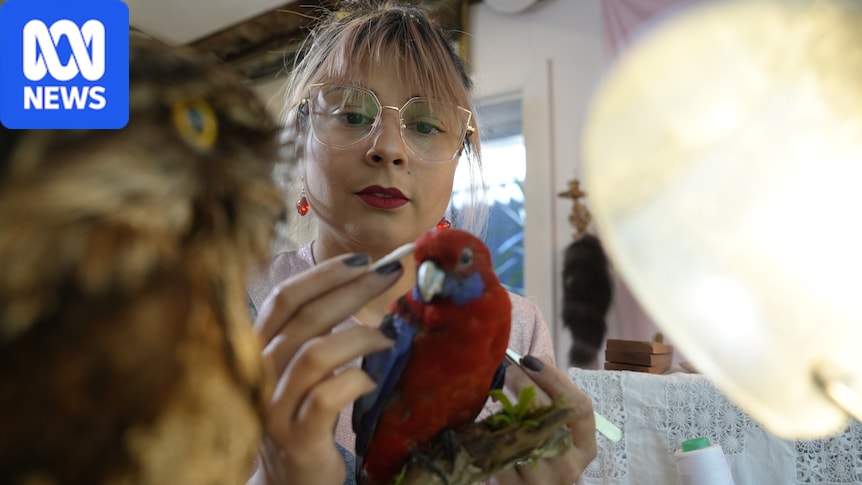
From finches to mice and rabbits to parrots, Roshana Van der Wall loves to practice taxidermy. (ABC News: Simon Amery)
Roshana Van der Wall's workspace is typical of many taxidermists.
There is a jar of glass eyes, a scalpel and a sharp objects bin, along with a pot of fine-tip paintbrushes on her desk.
A taxidermied mynah bird perched on a teacup sits nearby too.
It was a primary school museum excursion decades ago that piqued Dr Van der Wall's interest.
The experience even made her consider getting her cat taxidermied upon its death.
Decades on from her school excursion, Dr Van der Wall's love for this art form has not diminished in the slightest. (ABC News: Simon Amery)
Years later when her cat did pass on, Dr Van der Wall did not have the resources to taxidermy her pet — so following a standard burial, she researched everything she could about the practice.
Starting with a chick, Dr Van der Wall then taxidermied rats, birds and rabbits, her confidence growing with each finished piece.
The cocktaoo is mounted in a pose typical for cockatoos — perched upon a branch of Banksia that this species feeds on. (Supplied)
Her recent commission from Central Coast Council for their education centres was a yellow-tailed black cockatoo with the specimen provided by the council's environmental education officers.
A research scientist by day, Dr Van der Wall sees taxidermy as a passion she one day wishes to pursue full-time.
Katrina McCormick uses a variety of methods to prepare animals for presentation and preservation, such as using flesh-eating beetles. (ABC News: Marcus Stimson)
For 20 years Katrina McCormick has been a natural science preparator at the Australian Museum in Sydney, after starting at the organisation in a volunteering capacity.
The taxidermy process typically starts with skinning an animal.
For animals except birds, the skin is then tanned, meaning treated, and fitted over an artificial body, often made from carved foam or sculpted wire.
Ms McCormick's role includes creating displays in the museum, but mainly preparing skins and skeletons for the research collection.
Ms McCormick is assembling the parts of the leatherback turtleahead of its display. (ABC News: Marcus Stimson)
To clean the bones of some animals and birds, she uses a colony of flesh-eating beetles.
"Recently there was a leatherback turtle that washed up and I prepared the skeletal material," she said.
"It was a huge effort. I was wearing waders that still are imbued with the smell of the leatherback."
The Australian Museum's specimens come from Taronga Zoo, public donations and also national parks thanks to authorisation from relevant bodies.
A large part of Ms McCormick's role is preparing skins and skeletons for the research collection. (ABC News: Marcus Stimson)
Once a syllabus offered in tertiary education, taxidermy has not been formally taught in Australia since the 1970s.
Those like Dr Van der Wall who wished to learn the art form looked to mentors or small businesses both nationally or overseas.
Dr Van der Wall learnt the art and science of taxidermy via a group of Melbourne-based taxidermists. (ABC News: Simon Amery)
"You either have to attach yourself to a taxidermist or do it yourself trial and error. I wanted to learn properly in a set environment," she said, crediting a group of Melbourne-based taxidermists.
"There's a place for it [formal qualifications], especially in conservation degrees and museum studies."
Ms McCormick got her start after seeing an advertisement in her local newspaper in New Zealand, looking for an airbrush artist job for a taxidermist.
"I referred to myself at the time as a makeup artist for dead animals," Ms McCormick said, noting she picked up skills along the way from colleagues.
"I think it's an interesting point and that it could consolidate a lot of information and practice that goes on. But I suppose that's what the internet is for these days," she said of the potential for taxidermy education.
From foxes to a Sumatran tiger and a shark, Ms McCormick has prepared a number of specimens. (ABC News: Marcus Stimson)
Despite Australia not having a formal qualification process, taxidermists are allowed to preserve Australian native specimens in NSW outlined by the Biodiversity Conservation Act (2016) under a professional taxidermy licence.
A licensed taxidermist is only authorised to possess, buy, sell and trade specimens from animals they did not harm.
In 2024, a total of 10 licences authorising taxidermy were granted. There are currently 60 valid licences in NSW.
NSW has professional taxidermy licences. (ABC News: Marcus Stimson)
A NSW Department of Climate Change, Energy, the Environment and Water spokesperson said taxidermy gives people the "opportunity to encounter our rarer species".
"Taxidermy enables them to see the species, while highlighting the animal or bird's rarity and need for conservation," they said.
"Similarly in a museum setting, the shape, fur or feathers, and different parts of an animal can be clearly seen and examined up-close without stressing or harming a live animal, helping to educate thousands of visitors a day."
There are currently 60 valid taxidermist licences in NSW. (ABC News: Simon Amery)
Dr Van der Wall works with roadkill, euthanised ferals or people's pets that have been brought to her for memorial work.
"I don't like people hiding behind the phrase 'ethical taxidermy'. I think it can be a bit grey because ethics vary person to person," she said.
"Instead, I say I do sustainable taxidermy which means I don't take things from their environment and nothing is killed for the work."
Ms McCormick added: "It's a rich journey — the privilege of the proximity to extraordinary creatures is quite amazing.
"It's not the macabre pursuit it's perceived to be."
See more ABC coverage in your search results
Topic:Child Abuse
Topic:Food and Drink
Topic:Oil and Gas
LIVE
Topic:Federal Government
Topic:Apprenticeships
Topic:Science
Topic:Fish
Animals
Darlinghurst
Human Interest
Science
Sydney
Topic:Child Abuse
Topic:Food and Drink
Topic:Explainer
LIVE
Topic:Federal Government
Topic:Fires
Tue 28 Jul 2026 at 1:42am
Topic:World Politics
Tue 28 Jul 2026 at 12:18am
Topic:Contemporary Art
Tue 28 Jul 2026 at 12:01am
Topic:Oil and Gas
Mon 27 Jul 2026 at 10:30pm
Your home of Australian stories, conversations and events that shape our nation.
This service may include material from Agence France-Presse (AFP), APTN, Reuters, AAP, CNN and the BBC World Service which is copyright and cannot be reproduced.
Get the latest ABC News delivered to your email inbox
Stay informed and connected with the ABC. Covering a wide range of topics and brands including News, iview, listen, and more.
