
Content
Alaska for $7 million: Why and how Russia sold its largest overseas peninsula – The New Voice of Ukraine
Jul
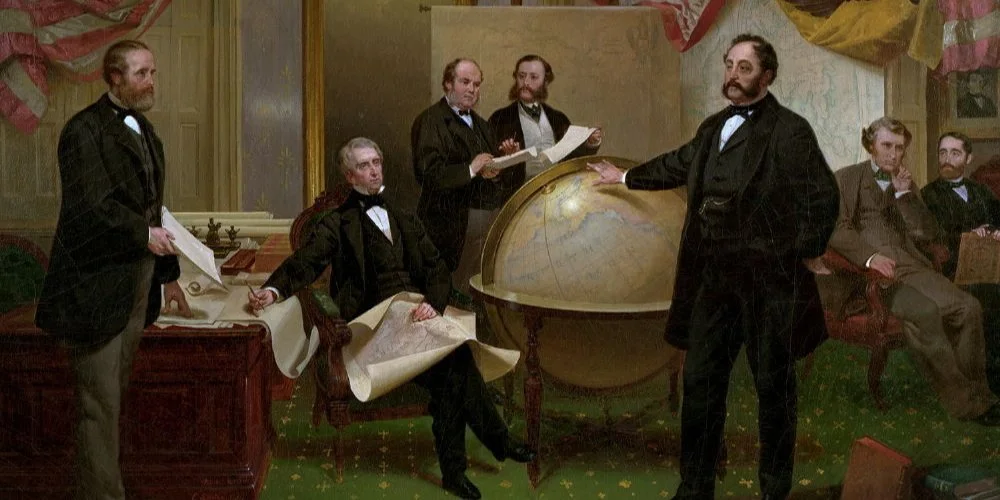
Painting by Emanuel Leutze *Signing of the Treaty on the Sale of Alaska, March 30, 1867*. Left to right: Robert S. Chew, William H. Seward, William Hunter, Vladimir Bodisko, Eduard de Stoeckl, Charles Sumner, Frederick Seward, 1868. (Photo: Akhistorycourse)
More than 150 years ago, the Russian Empire sold Alaska out of fear it might lose the territory in a future war with Great Britain. The buyer was the United States.
“Seward’s Folly” — that’s what many Americans called the now gold-rich state on the distant northern edge of the continent for years. In 1868, they purchased it from the Russians for just $7.2 million in gold — a bit over 11 million rubles at the time.
The man behind the deal — from concept to transaction — was U.S. Secretary of State William Seward. He endured a storm of condemnation from journalists and politicians, to the point that some feared he’d be assassinated. The Senate approved the purchase by only one vote. After all, who in their right mind would buy a frozen wasteland?
Ironically, it was the Russians who were eager to unload what had become a burdensome suitcase with no handle. Still reeling from their crushing defeat in the Crimean War, they feared Britain — the war’s main victor and Canada’s colonial ruler — could seize Alaska in the next conflict. London already knew there were rich gold and copper deposits near the peninsula’s edge, and a few mines had even started operating. In the event of another war, Britain would’ve had little trouble taking the territory.
Russia planted its flag on the peninsula in 1799, when expeditions led by Ivan Fyodorov and Mikhail Gvozdyov arrived by sea. Though some enterprising traders had long been scouring the region in search of cheap, high-quality furs — a sort of currency since early Muscovy.
Soon after, the Russian-American Company (RAC) was established in St. Petersburg and began sending merchants to what is now Alaska. By the time of the sale, fewer than a thousand Russians lived there — mostly RAC employees, military personnel, and the families of builders and support staff. They were vastly outnumbered by tens of thousands of Tlingits, the Indigenous people who never recognized Russian rule.
In March 1867, Russia’s ambassador Eduard de Stoeckl formally offered to sell the peninsula and the Aleutian Islands — more than 1.5 million square kilometers — to Washington. The decision was made by a special council in St. Petersburg that included Emperor Alexander II, his brother Grand Duke Konstantin, the ministers of finance and naval affairs, and Stoeckl himself.
The deliberations were almost secretive — how could one sell Russian land? They dragged on, ending with the deal signed at 4 a.m. The Russian side hoped for no less than $5 million, so the final amount felt like a generous gift.
When the Russian flag was lowered in Novo-Arkhangelsk (now Sitka), where the garrison was based, it took three tries. The flag was essentially torn down, falling onto the soldiers’ bayonets. The American flag went up the same mast immediately. Superstitious Russians later claimed their banner simply didn’t want to leave Alaska — that the sale had been a grave mistake.
That idea soon gave rise to persistent legends throughout the empire. Some claimed it was Catherine the Great — widely disliked for her supposed insatiable lust — who sold Alaska. Others believed the U.S. ship Orkney, which was allegedly carrying the gold payment to St. Petersburg, sank in a storm. During the Soviet era, nearly everyone believed Alaska hadn’t been sold at all — merely leased to the U.S. for 99 years.
The name “Alaska,” derived from the language of the Indigenous Aleuts living on nearby islands, was proposed by Senator Charles Sumner, who led the campaign to approve the purchase in the U.S. Senate.
Gold was discovered almost immediately after the agreement. But the information was kept secret — the government lacked the infrastructure to manage mining, and any publicity would have triggered a flood of prospectors.
And that’s exactly what happened in August 1896, when nuggets were found by chance at Bonanza Creek, a tributary of the Klondike River. Hundreds of fortune-seekers soon poured in. Charlie Chaplin famously captured the chaos in his 1925 film The Gold Rush.
Now, the region has drawn another visitor — the Russian dictator, ever greedy for someone else’s land.
The military war may be swinging in our favor, but the information war continues.
Just as an army needs soldiers, so does a free society need its journalists to ensure that people have access to honest, trustworthy voices to understand the world around them.
For the past five years, The New Voice of Ukraine has been working tirelessly to push back against Russian narratives and defend democracy. But we cannot do it alone.
Please consider supporting us on Patreon for just $5 a month – your donation does directly to supporting journalists and ensuring that this front of the infowar says solid and defended.
Thank you.
Follow us on Twitter, Facebook and Google News
If you find an error in the text, select it with the mouse and click
Теги: Alaska Alaska LNG Alaska summit Trump Putin Alaska meeting Alaska summit Trump Putin Alaska symbolism Alaska summit 2025 Alaska summit Putin Trump
NV Премиум это:
or
Продолжить читать материалы открытого доступа
назад ко входу
Мы отправили вам письмо с ссылкой на создание нового пароля
Если письмо не пришло в течение нескольких минут, пожалуйста, проверьте папку Спам.
В случае возникновения проблем, пожалуйста, напишите в службу поддержки support@nv.ua
About using cookies
By continuing to browse NV.ua, you confirm that you have read the Terms of Use of the site and agree to the use of cookies.
